

 By Coco
Compare the complete manufacturing route for a realistic load case.
Casting vs forging hollow parts is best assessed through the finished geometry and operating loads. Forging deforms solid metal, while casting solidifies metal in a mold. Those routes can produce different material structures and manufacturing constraints, but neither label alone establishes whether a particular component is safe, economical or fit for purpose.
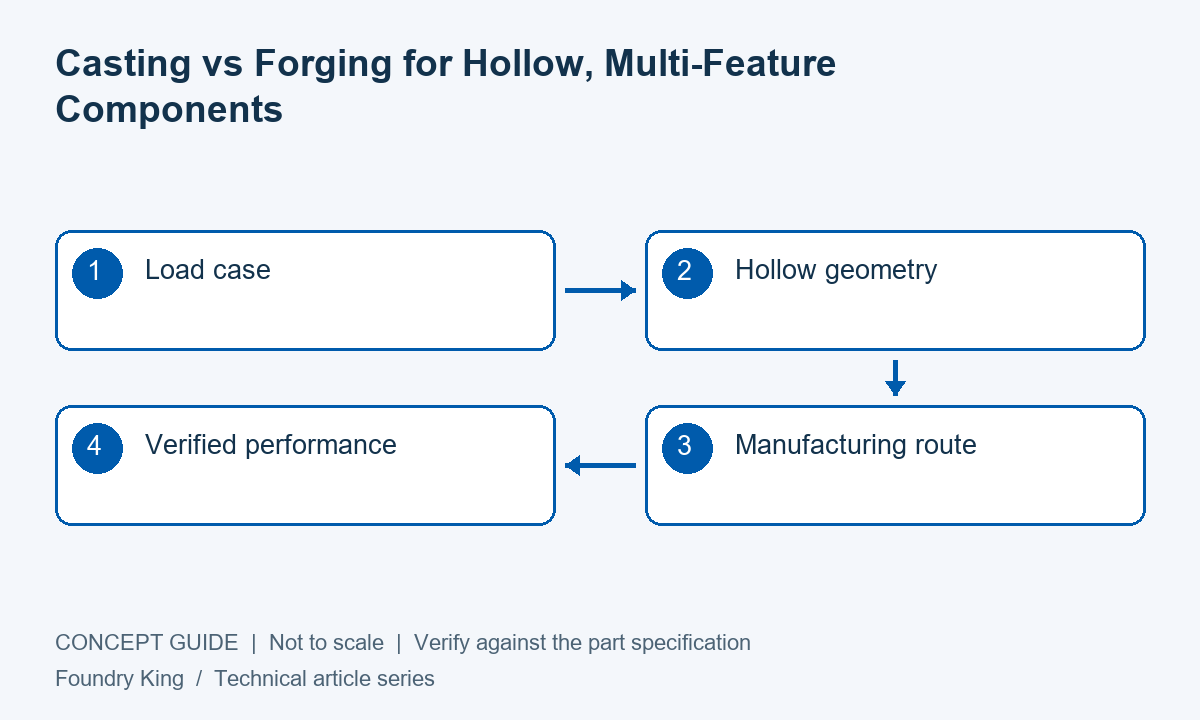
Define the load case first
Static load, cyclic loading, impact and pressure can lead to different design priorities. Provide the relevant mechanical requirements and identify highly stressed regions. A generic request for the strongest possible material is less useful than a clear description of loading, temperature and the consequence of failure.
Forging can provide directional material characteristics associated with deformation. Castings require attention to soundness, section transitions and the material’s specified condition. Compare properties and acceptance requirements for the actual alloy and product form rather than substituting a handbook value from another condition.
Evaluate hollow geometry and access
Casting can incorporate internal cavities using suitable cores or other process features. A forged starting form may need drilling, machining, splitting or joining to create the same passage. Those added operations can change material yield, cycle time and the inspection burden.
The casting option also has limits. Complex cavities need stable core support, cleaning access and a way to verify the internal result. An uncleanable or uninspectable passage does not become acceptable simply because it is near-net shape. Review the difficult internal feature in both proposed routes.
Include the final machining setup
Forged and cast blanks both need a plan for locating and machining functional surfaces. Compare workholding, stock distribution and access to critical features. A more expensive blank may still reduce total cost if it simplifies machining or improves yield.
For either route, define how the finished part retains traceability after material is removed. If heat treatment or straightening can affect geometry, specify when dimensions are checked. Evidence from a raw blank may not demonstrate the final delivered component.
Compare evidence, not slogans
| Issue | Casting review | Forging review |
|---|---|---|
| Hollow passages | Core route and internal cleanliness | Machining or joining needed to create cavity |
| Mechanical duty | Grade, treatment and integrity acceptance | Grade, treatment and relevant directional properties |
| Cost | Tooling, yield, finishing and inspection | Dies, material use, machining and inspection |
Use a complete cost boundary
Include tooling, development samples, material, machining, testing and logistics. If an assembly is proposed instead of a one-piece component, include joining and inspection of the joint. The cheapest raw part does not necessarily produce the lowest installed cost.
Where performance is critical, the designer must evaluate the specific manufacturing route and applicable standards. A supplier comparison should support that engineering decision rather than replacing it with the blanket claim that casting or forging is always better.
Frequently asked questions
Is every forging stronger than every casting?
No. Strength depends on alloy, processing, heat treatment, geometry and loading. Compare specified properties and actual acceptance evidence.
Can a casting replace a forging without a drawing review?
It should be assessed as an engineering change. Material behavior, defects, geometry, inspection and qualification may all need review.
Discuss your component requirements
For related information, review general forging and investment casting comparison, or review a hollow component. Include the drawing revision, alloy, quantities and critical acceptance requirements so the proposed route can be reviewed against the actual part.

Get Premium Casting Products
Join foundryking.com Newsletter to get more information of different premium OEM Casting products in China.


