

 By Coco
Make the internal geometry manufacturable, measurable and cleanable.
Sand casting core design determines internal passages that may never be directly visible after the casting is complete. A correctly sized exterior does not prove that the core stayed in position or that every passage was cleaned. For hollow housings and flow components, core design deserves a dedicated review with the foundry and the equipment engineer.
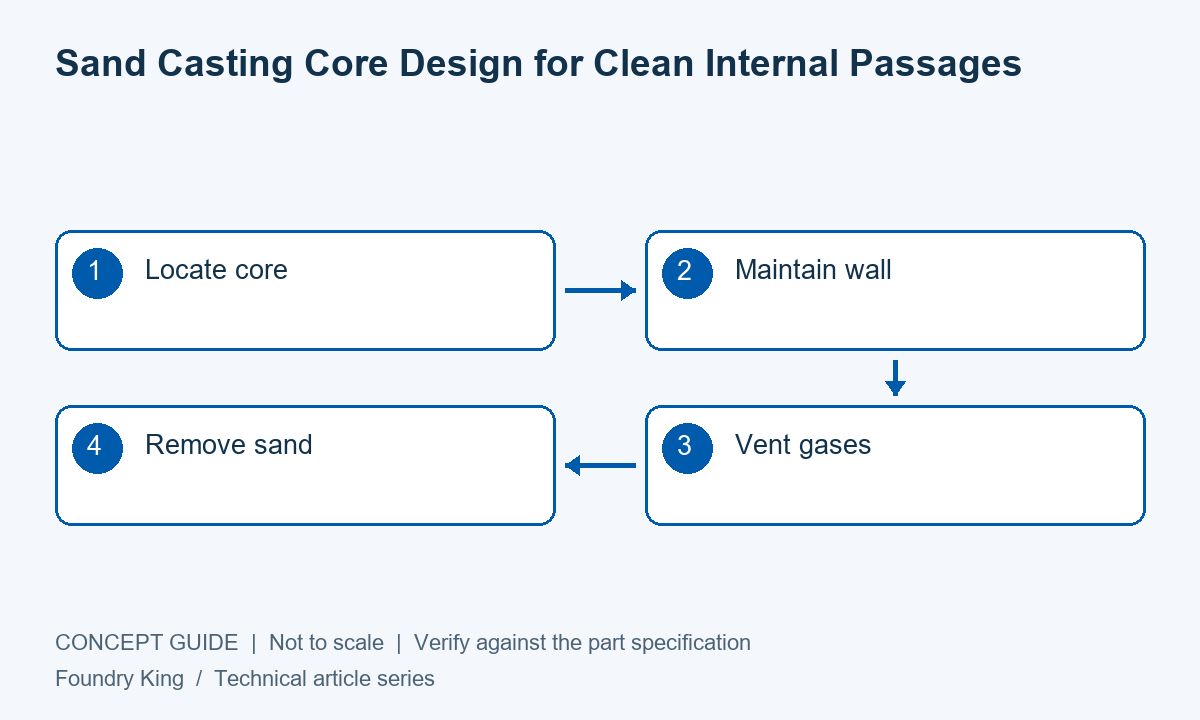
Provide stable core location
Core prints create locating and support features in the mold. Their arrangement must resist movement during assembly and pouring without making the mold impossible to close. A long core supported only at one end can behave differently from a shorter, well-located core, even when both reproduce the nominal CAD shape.
Define where wall thickness matters and how core displacement will be evaluated. If the specification only lists outside dimensions, a shifted core can escape detection. Use a practical measurement plan for the internal-to-external relationship, such as accessible thickness checks, sectioned trials or a suitable volumetric method.
Balance strength with gas management
The core needs enough strength for manufacture, storage, assembly and exposure to molten metal. Its binder also contributes gases during pouring. Selection therefore involves strength, permeability, thermal behavior and the route by which gas can escape; simply increasing binder is not a universal remedy for breakage.
Discuss venting without prescribing unsupported details from a different alloy or geometry. The foundry should be able to explain how the proposed core package manages gas and where trial evidence is needed. Record changes made during development so the production version matches the approved method.
Plan cleaning before closing the design
Narrow blind passages, abrupt pockets and complex turns can make sand removal difficult. A core that can be manufactured is not automatically removable from the finished casting. If internal residue is unacceptable, provide a cleanliness requirement and evaluate cleaning access while the design is still editable.
Where access holes or plugs are proposed, review their effect on sealing, assembly and service maintenance. A cleaning opening should not create an undocumented pressure boundary or interfere with the customer’s installation. Coordinate the casting, machining and final assembly drawings.
Select evidence for each risk
| Risk | Useful design response | Possible validation |
|---|---|---|
| Core movement | Improve prints or assembly support | Wall-thickness and location checks |
| Gas-related defects | Review binder, venting and filling | Targeted integrity examination |
| Trapped sand | Improve access and cleanability | Borescope, flushing or agreed cleanliness test |
Keep interfaces between suppliers clear
If one business casts the housing and another machines or assembles it, define who removes residual core material and who confirms cleanliness. An assumption at this interface can leave the final assembler responsible for a defect that is difficult to identify after delivery.
For repeat orders, retain identification of core boxes and the approved assembly method. Changes to core design can alter wall thickness, flow area and machining stock even when the external pattern is unchanged. Treat them as engineering changes, not invisible workshop adjustments.
Frequently asked questions
Does an external dimensional report prove internal alignment?
Only if its measurements actually establish that relationship. Exterior sizes alone do not demonstrate core position.
Must every core be checked with CT?
No. Choose a technically suitable method based on access, risk and acceptance needs. CT is one option, not a universal requirement.
Discuss your component requirements
For related information, review sand cast component examples, or discuss an internal-passage requirement. Include the drawing revision, alloy, quantities and critical acceptance requirements so the proposed route can be reviewed against the actual part.

Get Premium Casting Products
Join foundryking.com Newsletter to get more information of different premium OEM Casting products in China.


