

 By Coco
Evaluate the environment around the casting, not only the alloy’s reputation.
Marine castings seawater service requires more than selecting a material described as corrosion resistant. Flow, temperature, oxygen conditions, crevices and contact with other metals can change the behavior of a component. The casting’s geometry, surface condition and mechanical duty should be reviewed together with the specific alloy and governing requirements.
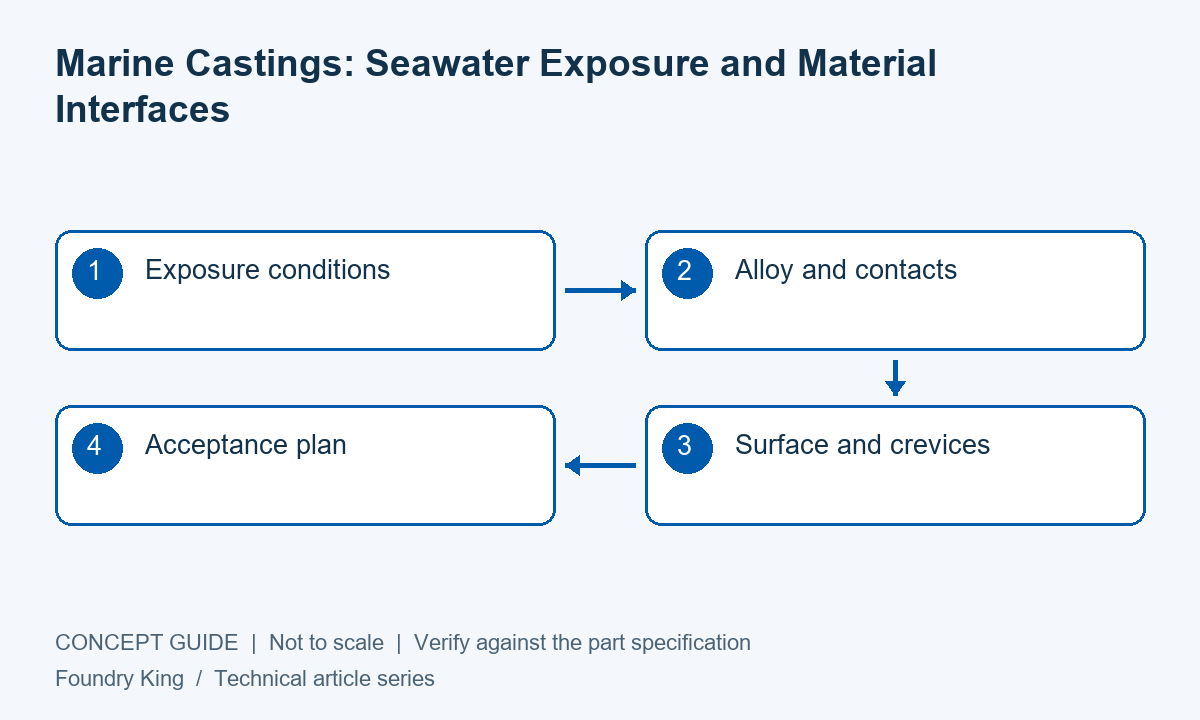
Describe the exposure precisely
Distinguish permanent immersion, splash, atmospheric exposure and intermittent wetting. Include the fluid temperature, likely stagnation, contaminants and cleaning. These conditions can differ substantially even on the same vessel or installation.
Do not use a generic seawater claim as a substitute for a material-selection review. The equipment designer or corrosion specialist should evaluate critical applications. A grade successful in one flow condition may not perform similarly in a stagnant crevice or another temperature range.
Review dissimilar-metal contact
Fasteners, shafts, fittings and neighboring structures can create material interfaces that influence corrosion. Consider the complete assembly and any protective measures required by the design. Selecting the casting alloy in isolation can overlook a problem created at installation.
Crevices and drainage also deserve attention. A small geometric change can alter where water and deposits remain. Review sealing, maintenance access and cleaning rather than expecting an alloy upgrade to compensate for every unfavorable detail.
Specify material and surface condition
Use the actual casting grade, required condition and test scope. Common labels such as marine bronze or marine stainless are not complete purchase specifications. Cast, forged and wrought product requirements should not be interchanged without approval.
Specify any required cleaning or surface treatment, and identify protected functional surfaces. Contamination and rough or inaccessible regions can affect performance. A bright exterior does not prove that every internal passage has the same condition.
Coordinate integrity and application evidence
| Review area | Question | Useful requirement |
|---|---|---|
| Environment | Where and how is the part exposed? | Documented service conditions |
| Interfaces | Which other metals and crevices are present? | Assembly and protection review |
| Casting quality | What regions are critical? | Specified examination and traceability |
Keep claims within the evidence
Where classification, customer or application approval is required, establish it explicitly. Do not imply that a generic casting is approved for all marine equipment. Material conformity and component design approval are related but separate matters.
For repeat supply, maintain the approved alloy, surface route and inspection plan. If field experience reveals corrosion, record its location and operating context before changing the grade. The failure may involve installation, crevice geometry or exposure as well as material.
Frequently asked questions
Is 316 stainless steel always safe in seawater?
No. Actual conditions and component design matter, and critical applications require a specific assessment.
Does “marine grade” identify one standard alloy?
No. It is an imprecise description unless linked to a defined specification, condition and application requirement.
Discuss your component requirements
For related information, review marine casting component examples, or discuss marine exposure and material requirements. Include the drawing revision, alloy, quantities and critical acceptance requirements so the proposed route can be reviewed against the actual part.

Get Premium Casting Products
Join foundryking.com Newsletter to get more information of different premium OEM Casting products in China.


