

 By Coco
Match the wear mechanism to the material rather than choosing by hardness alone.
Manganese steel castings are often discussed in applications involving impact and wear. Their useful behavior depends on the actual alloy, heat treatment and service conditions, including whether the surface receives loading capable of producing the intended work-hardening response. A material successful in one crusher duty may not be the best choice for low-impact sliding abrasion.
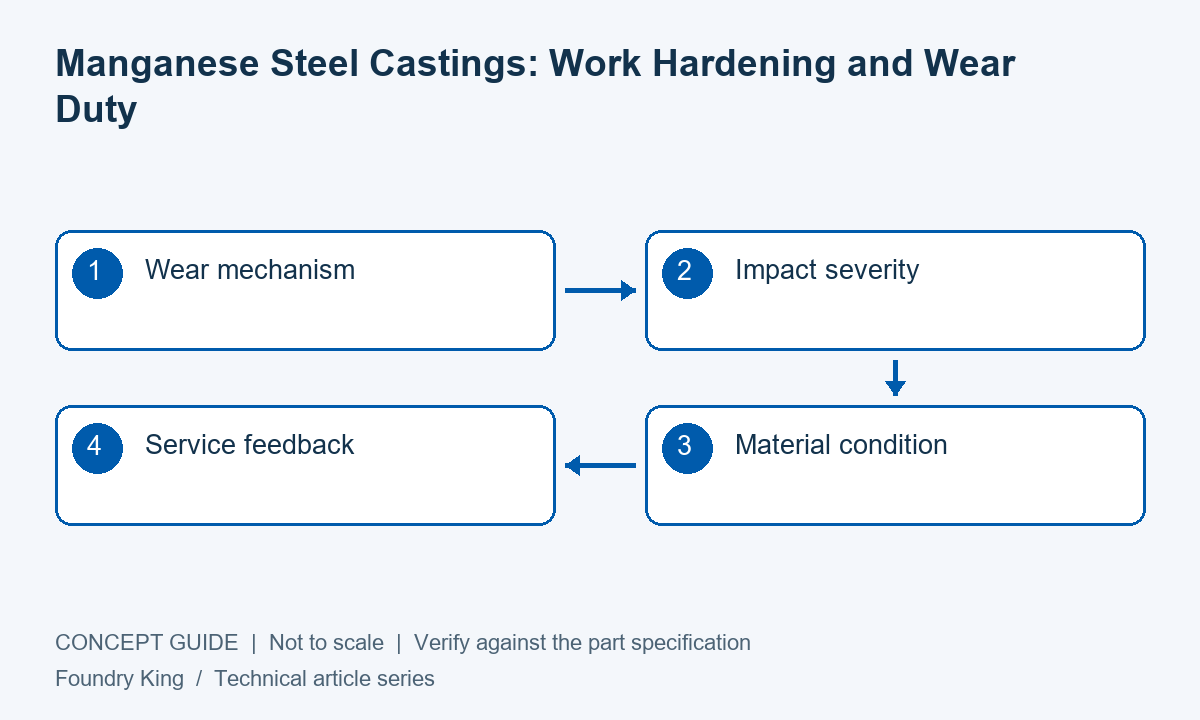
Identify the wear mechanism
Describe what contacts the component, the particle size and the relative movement. Gouging, sliding abrasion and repeated impact are not identical conditions. Include whether the part is supported rigidly and how contact pressure varies through the operating cycle.
Review failed parts where available. Their wear pattern can show whether material is being cut, deformed, cracked or lost by another mechanism. A replacement decision based only on the original weight loss can overlook the reason the component failed early.
Understand work hardening in context
Some manganese steel grades can harden at the working surface under suitable deformation and impact. That does not mean every surface becomes uniformly hard in every application. The initial material condition, actual loading and geometry influence the result.
Avoid specifying a universally high delivered hardness without considering the intended grade and duty. The requirements should follow the applicable material standard and engineering basis. A service-hardening mechanism is different from buying a material whose entire section must meet an as-delivered hardness target.
Review manufacture and machining
Casting method, section geometry and heat treatment affect the supplied component. Heavy regions, abrupt transitions and local stresses deserve review. The purchase specification should identify the grade and condition rather than ordering only “manganese wear steel.”
Machining requirements must also be communicated early. Holes, locating faces and fits may need a planned route suitable for the material condition. Changes in geometry or later field modifications can become difficult if the original design did not account for this work.
Build an application record
| Factor | Information to provide | Why it affects selection |
|---|---|---|
| Impact | Load character and contact conditions | Influences useful work-hardening behavior |
| Abrasion | Particle and movement description | Distinguishes wear mechanisms |
| Component | Section, support and functional interfaces | Affects manufacture, stress and maintenance |
Evaluate life by a consistent measure
Compare components using operating hours, processed material or another meaningful duty measure. A longer calendar life can be misleading if throughput or feed conditions changed. Record installation details and the reason each part was removed from service.
Use that feedback to review grade and geometry with the responsible engineer. The best improvement may involve support, section shape or operating practice as well as material. Avoid making an unsupported promise of a fixed life increase without representative service evidence.
Frequently asked questions
Is manganese steel the best material for all abrasive wear?
No. Wear mechanism and impact conditions matter, and alternative materials may suit other duties better.
Can one initial hardness reading predict service life?
Not reliably. Material condition, loading, geometry and operating conditions all contribute.
Discuss your component requirements
For related information, review wear-related casting components, or discuss the actual wear duty. Include the drawing revision, alloy, quantities and critical acceptance requirements so the proposed route can be reviewed against the actual part.

Get Premium Casting Products
Join foundryking.com Newsletter to get more information of different premium OEM Casting products in China.


