

 By Coco
Buy the right amount of production preparation for the demand you can justify.
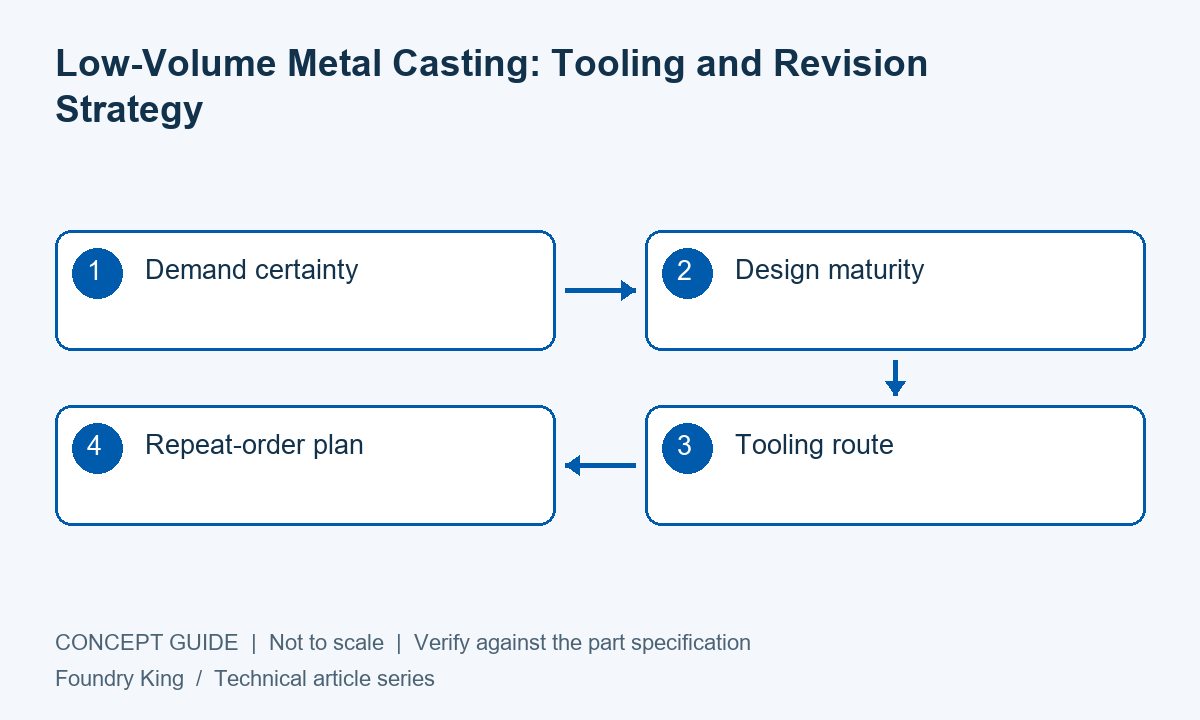
Low volume metal casting does not mean that every part can be made economically with minimal preparation. A small order with complex cores and tight functional requirements can need substantial engineering. The useful strategy is to align tooling investment with design maturity, expected repeat demand and the evidence needed to accept the component.
Separate prototype and production goals
A prototype may be needed to prove fit, establish a casting method or qualify material and inspection. These are different objectives. If the sample uses a different alloy or manufacturing route from production, clearly state what its success demonstrates and what remains unproven.
For a new component, identify which design features are still likely to change. Tooling chosen before those issues are settled can create repeated modification costs. A more flexible initial route may help development, provided the transition to production is defined rather than left implicit.
Compare practical tooling options
Discuss pattern construction, expendable-pattern options and printed molds or cores where appropriate. Each has different costs, handling characteristics and revision implications. The cheapest initial tool may need more manual work or may not support the intended repeat quantity reliably.
Include core boxes and fixtures in the estimate. A hollow casting can require more preparation for its internal geometry than for its exterior. Ask what tooling is included, who owns it and what changes would require a new quotation.
Model the order pattern
Annual quantity, delivery batch and expected lifetime demand are not interchangeable. A supplier may quote an efficient production lot that is larger than the customer’s immediate requirement. Compare the carrying cost and supply risk of that proposal with the cost of smaller production batches.
Do not use an unsupported universal minimum order quantity. The practical minimum depends on metal, melt planning, tooling, part complexity and the foundry’s production setup. Ask the supplier to explain its minimum in relation to the proposed route.
Compare accepted finished parts
| Cost category | Include in the estimate | Check before ordering |
|---|---|---|
| Development | Engineering, tooling and sample approval | What happens after a design revision? |
| Production | Molding, metal, cleaning and finishing | What batch size supports the quotation? |
| Verification | Material and component inspection | Which reports and tests are included? |
Preserve a repeat-order baseline
After sample approval, retain the drawing revision, tooling identity and agreed delivered condition. A later order should not need to reconstruct these decisions from old emails. If the tooling has been stored for an extended period, confirm its condition and any maintenance required before production.
Low-volume projects benefit from an explicit change-control agreement. A small quantity does not remove the need to approve substitutions, repairs or altered inspection. Clear requirements can prevent the cost of one rejected batch from exceeding the original tooling savings.
Frequently asked questions
Is machining always better for a small order?
No. Internal geometry, material yield and machining access can make casting worth evaluating even at low quantities.
Should prototype tooling automatically become production tooling?
Only if it supports the approved production route, quality requirements and expected demand.
Discuss your component requirements
For related information, review custom casting information, or discuss quantities and design maturity. Include the drawing revision, alloy, quantities and critical acceptance requirements so the proposed route can be reviewed against the actual part.

Get Premium Casting Products
Join foundryking.com Newsletter to get more information of different premium OEM Casting products in China.


