

 By Coco
Evaluate the alloy and the finished seal before comparing raw casting prices.
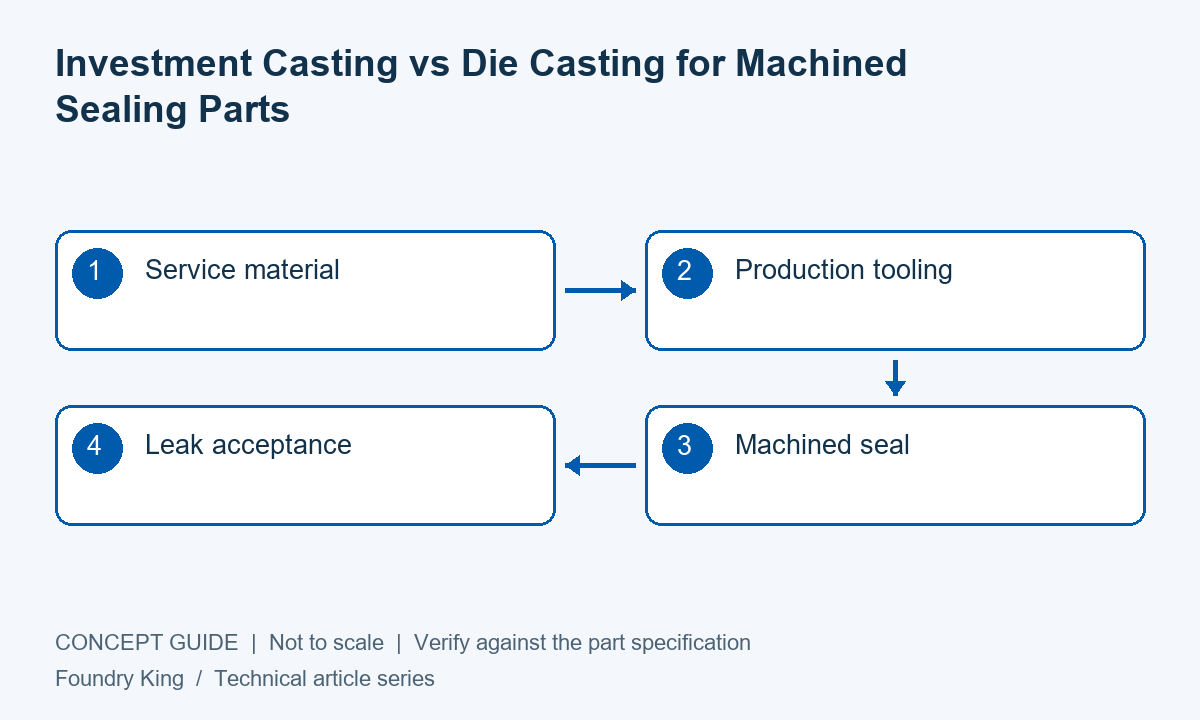
Investment casting vs die casting becomes a different question when the part must seal after machining. The raw casting’s appearance is only one factor. Alloy compatibility, the location of machining, potential defect exposure and the final test requirement can determine the viable route before production volume is considered.
Begin with the material requirement
Investment casting is used with many alloy families, including steels and stainless steels. Conventional high-pressure die casting is commonly associated with lower-melting nonferrous alloys. A proposal to replace a steel component with aluminum therefore involves a material redesign, not merely a change in mold type.
Review temperature, corrosion, stiffness, fatigue and joining requirements before comparing routes. If the specified alloy is mandatory, that may narrow the process choice immediately. Do not accept an alloy substitution solely because the alternative casting quotation is cheaper.
Identify the sealing mechanism
An O-ring groove, a flat gasket face and a threaded pressure connection have different functional requirements. Specify the finished geometry, surface condition and relevant leak or pressure test. Clarify whether testing happens before or after machining and any coating or assembly operation.
Machining may reveal porosity that was not visible in the raw casting. Review the location and depth of material removal with both suppliers. A route that works well for a decorative cover may require additional development for a pressure-retaining housing.
Compare tooling and expected demand
Die casting generally involves a reusable production die with its own opening, ejection and maintenance requirements. Investment casting uses a different tooling and expendable-pattern route. The economic comparison should include tooling revisions, first-article work and the expected order pattern.
Use realistic volumes and separate initial and repeat-order costs. Avoid amortizing tooling over demand that has not been committed. If the design is still evolving, the price and timing of engineering changes can be as important as the initial unit cost.
Agree evidence for integrity
| Question | Why it changes selection | Useful evidence |
|---|---|---|
| Which alloy is required? | Limits feasible process and service behavior | Approved material specification |
| Where is the seal machined? | May expose internal discontinuities | Machined sample and defined examination |
| What must the part retain? | Determines acceptance beyond appearance | Specified leak or pressure test |
Make the final comparison fairly
Request the same delivered condition and inspection scope. Include heat treatment or surface processing only where appropriate for the actual material and route. The phrase “fully finished” should be broken down into specific operations and measurable results.
If a supplier proposes impregnation, repair or another special treatment, establish whether it is permitted by the application and customer specification. Such operations should not silently replace a required integrity level. Document approval, traceability and repeat-production controls before releasing the order.
Frequently asked questions
Is investment casting automatically leak-free?
No. Filling, feeding, alloy handling and geometry still influence integrity. Verify the finished component using agreed acceptance criteria.
Can die casting be used for pressure components?
Some applications use qualified die-casting routes, but suitability depends on material, design, processing and the actual test requirements.
Discuss your component requirements
For related information, review die cast component options, or investment cast component options. Include the drawing revision, alloy, quantities and critical acceptance requirements so the proposed route can be reviewed against the actual part.

Get Premium Casting Products
Join foundryking.com Newsletter to get more information of different premium OEM Casting products in China.


