

 By Coco
Look beyond the lost-wax sequence and identify where precision is actually established.
Investment casting process parameters influence the accuracy and integrity of a component long before it reaches a measuring bench. A wax pattern can distort, a ceramic shell can crack, and an unfavorable section junction can remain difficult to feed. Buyers do not need to prescribe a foundry’s recipe, but they should understand which controls support the features that matter on their drawing.
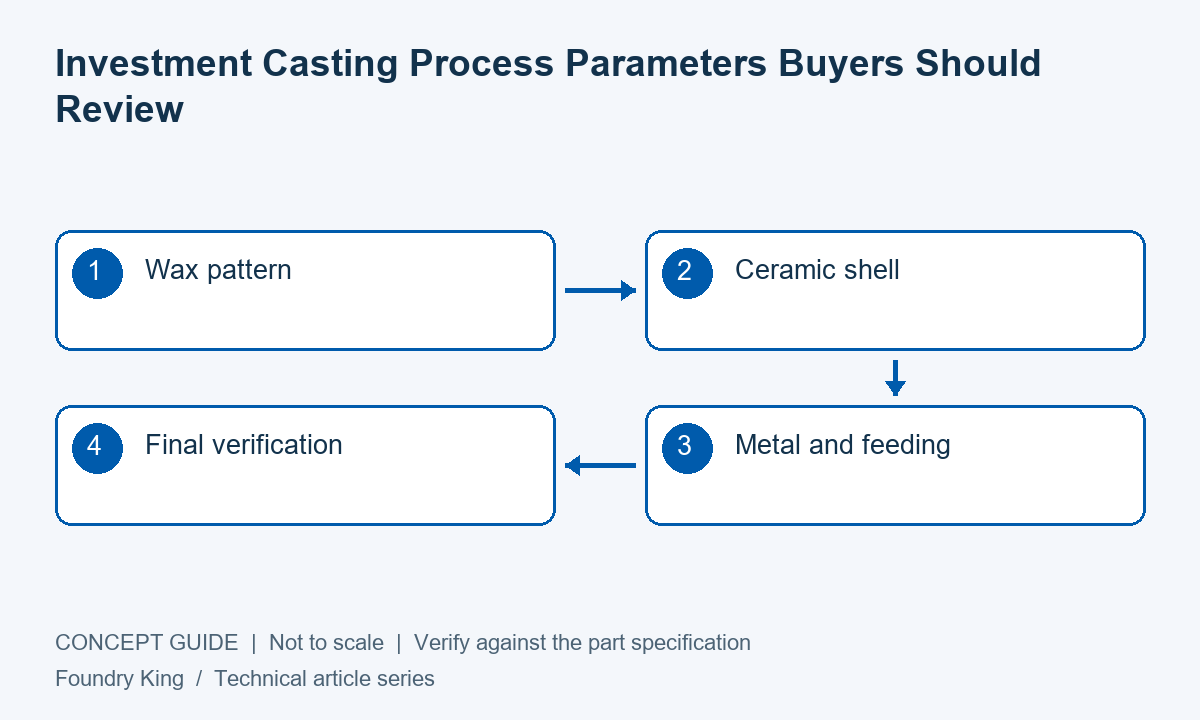
Establish the pattern baseline
Wax injection reproduces the tooling cavity, but the resulting pattern is not automatically dimensionally stable. Tool condition, wax handling, cooling and storage influence the shape that reaches assembly. Long thin sections and large flat surfaces deserve particular attention because distortion can create variation that later operations cannot fully remove.
Review the tooling concept with the final machining scheme. A locating pad or a slightly revised transition can simplify both wax handling and machining. Conversely, a detail added solely to improve castability may interfere with an assembly. Keep the customer drawing and the foundry’s process drawing coordinated through a controlled revision review.
Treat shell building as an engineered operation
Repeated slurry dipping and refractory coating build the ceramic shell around the pattern assembly. Drying conditions and shell consistency matter because the shell must survive dewaxing, firing and contact with molten metal. More coating is not automatically better: the shell design must balance handling strength, thermal behavior and the demands of the alloy.
The wax is removed before the casting pour. Shell damage at this stage can produce fins, leakage or more serious casting defects. For a new geometry, ask how shell integrity is checked and how the foundry manages fragile features. Avoid writing an arbitrary drying duration into a purchase order unless it is part of a qualified process specification.
Match filling and feeding to the alloy
Molten-metal temperature, shell temperature, filling route and section thickness interact. A thin feature may be difficult to fill; a thick junction may develop shrinkage even when the exterior is complete. Carbon steel, stainless steel and other alloy families do not share one universal pouring condition or contraction factor.
The gate location also affects finishing. Removal should not damage a sealing face or leave an unacceptable witness on a functional surface. Agree where gate scars may remain, which surfaces will be blended, and which features will be machined. This is easier during design review than after the first batch has been cut from its trees.
Separate cosmetic and functional requirements
| Requirement | Clarification needed | Useful approval evidence |
|---|---|---|
| Surface appearance | Permitted witness marks and blending areas | Approved sample or visual standard |
| Dimensional accuracy | As-cast versus machined dimensions | First-article dimensional report |
| Material integrity | Test method, location and acceptance | Traceable inspection records |
Review the finishing route
Shell removal, cutoff, blasting, heat treatment and straightening can each influence the delivered condition. Specify when critical dimensions are measured relative to these operations. A part measured before heat treatment may not demonstrate its final form, while aggressive blending can erase identification or reduce local wall thickness.
For stainless components, ask how contamination is controlled during finishing and whether additional cleaning or passivation is required by the application. Do not assume that a bright surface proves corrosion performance. The alloy, heat treatment, surface condition and service environment all contribute to suitability.
Turn the review into an acceptance plan
Document the approved alloy, drawing revision, sampling plan and handling of deviations. If a feature is beyond the routine process capability, decide whether to machine it, redesign it or qualify a special control. Precision comes from a compatible design and a stable route, rather than from the word “investment” in a product description.
Frequently asked questions
Are lost-wax and investment casting different processes?
Lost-wax casting is a common name for investment casting. Distinguish specific pattern and shell routes when they matter, rather than treating the two names as separate capabilities.
Can every feature be supplied to machining tolerances?
No. Casting capability depends on geometry, size, alloy and process control. Functional dimensions may still require machining and verification.
Discuss your component requirements
For related information, review investment cast components, or request a process review. Include the drawing revision, alloy, quantities and critical acceptance requirements so the proposed route can be reviewed against the actual part.

Get Premium Casting Products
Join foundryking.com Newsletter to get more information of different premium OEM Casting products in China.


