

 By Coco
Select a defined wear-alloy grade for the real combination of abrasion and impact.
High chrome white iron vs Ni Hard is a comparison of wear-alloy families, not two universally interchangeable materials. Grades within these families differ, and performance depends on carbide structure, matrix condition, heat treatment and the actual service. A high hardness number alone does not establish the best material for a liner, pump component or other wear casting.
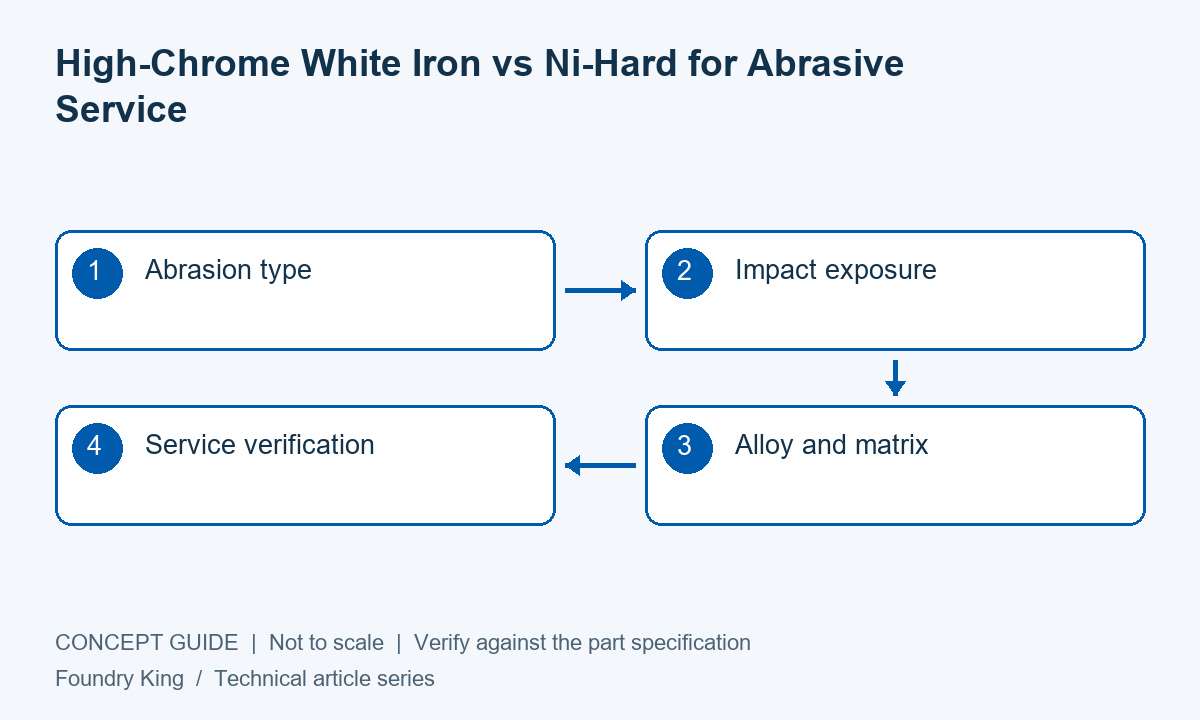
Describe abrasion and impact separately
Record the abrasive material, particle size, concentration and relative motion. Also identify impact, vibration and the way the part is supported. A material suitable for severe abrasion may be vulnerable when the same part experiences unexpected shock or bending.
Review whether corrosion and temperature contribute to damage. A wet slurry application is not identical to dry abrasion, and the interaction of mechanisms can affect material selection. Use application evidence rather than assigning a grade solely from a product-category name.
Specify a grade and condition
Common family names are insufficient for a complete order. Identify the required material standard, grade, heat-treatment condition and any supplementary requirements. Discuss what hardness measurement is required and where it is taken.
Do not assume a surface hardness reading represents the complete casting. Section effects, processing and the location of the measurement can matter. Where the specification requires further verification, agree the sampling and test basis before manufacture.
Review geometry for brittle behavior
White-iron wear alloys can require careful attention to impact and stress concentration. Sharp transitions, unsupported thin sections and bolt-loading arrangements may create risks unrelated to abrasive resistance. The mounting design should be reviewed with the material’s mechanical behavior in mind.
Communicate machining and finishing requirements early. Some features may need to be cast close to shape, ground or produced through a planned special route. An unreviewed field drilling or welding proposal can introduce damage or compromise the specified condition.
Compare more than unit price
| Selection factor | Question | Evidence to collect |
|---|---|---|
| Wear duty | What actually removes material? | Service observations and operating conditions |
| Mechanical risk | What impacts or bending occur? | Load and mounting review |
| Material conformity | Which grade and condition are ordered? | Traceable certificate and specified checks |
Use consistent service trials
Compare candidate parts over equivalent duty, not simply elapsed weeks. Changes in feed, throughput or operating settings can overwhelm the material difference. Record failure mode as well as remaining thickness or mass loss.
If a trial supports a change, update the approved specification and maintenance records. Keep the original acceptance requirements and document any revised handling restrictions. Material selection should produce a repeatable service improvement, not only a harder sample.
Frequently asked questions
Is the harder wear casting always the longer-lasting option?
No. Impact, support, corrosion, structure and the wear mechanism can change the result.
Can Ni-Hard be ordered without a specific grade?
A family name leaves important requirements unresolved. Define the grade and condition appropriate to the application.
Discuss your component requirements
For related information, review cast iron material information, or review a wear-casting specification. Include the drawing revision, alloy, quantities and critical acceptance requirements so the proposed route can be reviewed against the actual part.

Get Premium Casting Products
Join foundryking.com Newsletter to get more information of different premium OEM Casting products in China.


