

 By Coco
Describe the service conditions before choosing an alloy for a hot component.
Heat resistant castings operate in a combination of temperature, atmosphere and mechanical loading. A furnace tray that supports a batch has a different duty from a burner component exposed to combustion gases. Selecting a material from a maximum-temperature headline alone can overlook creep, oxidation, thermal fatigue or distortion that controls the useful life of the actual component.
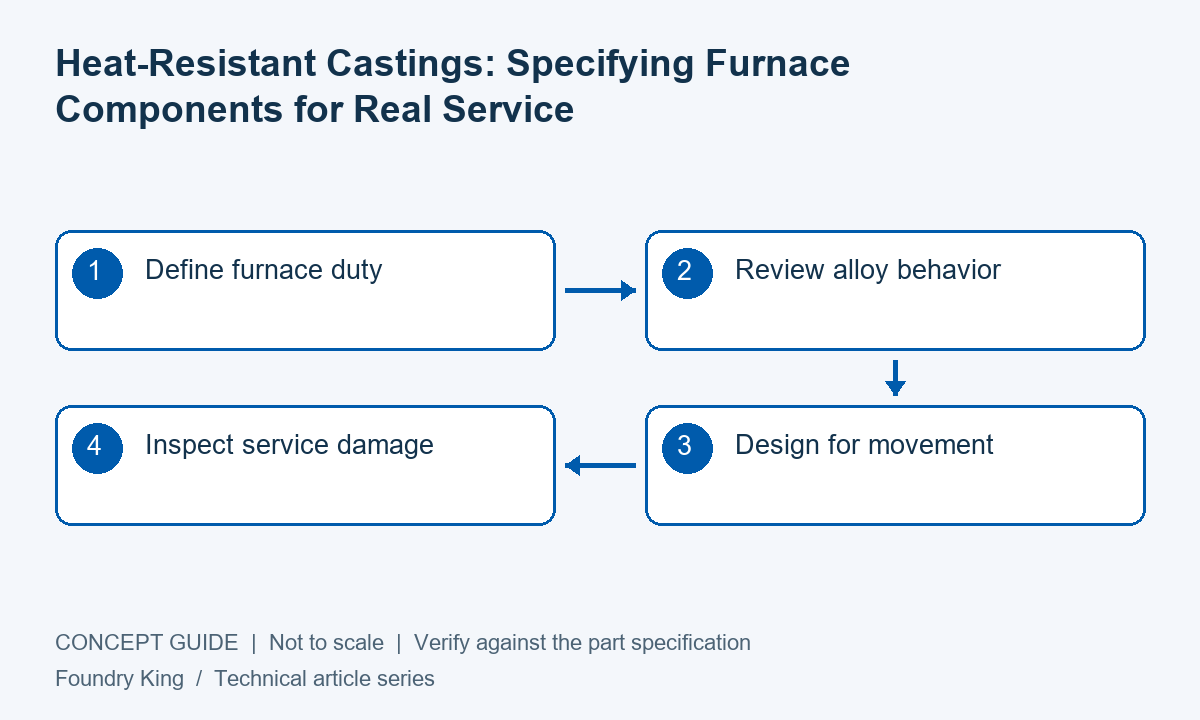
Record the complete operating cycle
Specify normal and peak metal temperatures, heating and cooling rates, dwell periods and shutdown frequency. Furnace setpoint and component temperature may differ, especially close to burners or where a thick load shields part of the casting. State how temperature was measured and which conditions represent regular service rather than an exceptional upset.
Atmosphere also matters. Oxidizing, reducing, carburizing and sulfur-bearing environments can affect alloys differently. Describe the process gas, contaminants and contact with the treated product. A successful alloy in a neighboring furnace is useful evidence only when the relevant environment and loading are comparable.
Consider time-dependent deformation
At elevated temperature, a component can progressively deform under a sustained load. Room-temperature tensile strength does not establish long-term resistance to that mechanism. Support span, load distribution and the permitted permanent deflection belong in the design discussion. Ask for service-relevant material data rather than assuming that a stronger ambient-temperature grade will last longer.
Ribs and thicker sections may improve stiffness but can also create thermal gradients and heavy junctions. Allow for expansion, provide sensible support conditions and review constraints at bolted connections. A component that cannot move as intended can crack or bend even when the nominal alloy selection is appropriate.
Convert service information into a specification
| Service input | Design implication | Evidence to retain |
|---|---|---|
| Sustained load and dwell | Creep and support review | Load pattern and acceptable deflection |
| Frequent temperature changes | Thermal fatigue review | Heating and cooling cycle |
| Aggressive atmosphere | Alloy compatibility review | Gas composition and service history |
| Restricted supports | Expansion and restraint review | Installation and clearance drawing |
Inspect before and after service
Define casting condition, dimensions and any required nondestructive inspection before delivery. Record critical spans, wall sections and support interfaces so later distortion can be compared with a baseline. Surface appearance alone cannot establish the remaining life of a hot component.
During maintenance, record the location of cracks, scaling, section loss and permanent movement. Photographs should show component orientation and furnace position. If failure repeatedly starts near a support or a particular hot zone, changing the alloy without reviewing installation and thermal distribution may leave the underlying cause in place.
Improve the next order using evidence
Keep the alloy designation, heat identity, drawing revision and service dates connected. Compare components that saw similar cycles and loads rather than comparing calendar life without context. When a replacement design changes section size, supports or alloy, document the reason and how its performance will be assessed. This turns a replacement purchase into a controlled improvement rather than an unrecorded experiment.
Frequently asked questions
Is a higher temperature rating always better?
No. Atmosphere, load, cycling and restraint can govern performance even below a material’s quoted temperature limit.
Can room-temperature testing predict furnace life?
It can verify specified delivery properties, but it does not replace service-relevant creep, oxidation or thermal-cycle evidence.
Discuss your component requirements
For related information, review steel casting options, or discuss furnace component requirements. Include the drawing revision, alloy, quantities and critical acceptance requirements so the proposed route can be reviewed against the actual part.

Get Premium Casting Products
Join foundryking.com Newsletter to get more information of different premium OEM Casting products in China.


