

 By Coco
Select the molding system against repeat demand, geometry and the cost of engineering changes.
Green sand vs no bake vs shell molding is not a simple ranking from low to high quality. Each route combines a molding system with tooling, equipment and a suitable range of component requirements. The best choice depends on what needs to repeat, how difficult the cores are and how much finishing is required after the mold is broken.
Compare tooling concepts first
Green sand typically uses reusable patterns to form moist, expendable sand molds. No-bake routes create rigid chemically cured molds. Shell molding uses heated tooling and resin-coated sand to form hardened shells. These differences affect tooling construction, handling and the practical cost of a revision.
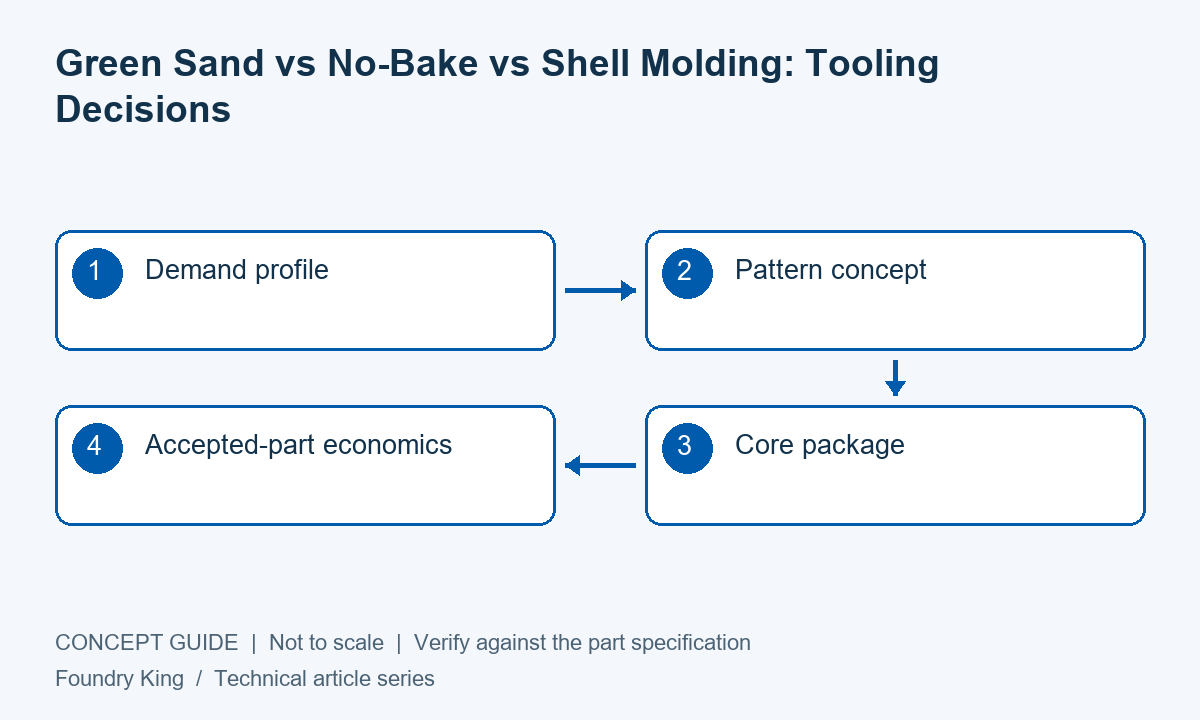
Ask for a pattern and core-box concept rather than comparing only three unit prices. If one route requires several extra cores or side pieces, its apparent molding advantage may disappear. Include the engineering work needed to prepare the method and approve the first production sample.
Match the system to production demand
Demand includes annual quantity, batch size and revision stability. A stable component ordered repeatedly can justify tooling that would be difficult to justify for a changing prototype. Conversely, low annual demand does not necessarily mean simple hand tooling is best if the geometry is difficult to mold reliably.
The actual foundry equipment matters. Two suppliers offering the same named molding process may have different size limits, automation and handling capabilities. Request evidence relevant to the proposed part rather than assuming the process label proves capacity or repeatability.
Treat cores as a separate cost center
Core manufacture, storage, assembly and cleaning can dominate a hollow casting’s production effort. A route with an inexpensive mold may still need an elaborate core package. Evaluate internal geometry, gas escape and dimensional location alongside the external pattern.
Where possible, improve access or simplify internal features before tooling release. A controlled design adjustment that removes one fragile core may save more than a modest reduction in mold material cost. The equipment designer must approve any effect on flow, sealing or assembly.
Use a consistent decision table
| Factor | Green sand | No-bake | Shell molding |
|---|---|---|---|
| Mold formation | Moist compacted sand | Chemically cured sand | Cured resin-coated sand shell |
| Main tooling question | Pattern and line compatibility | Parting, stripping and assembly | Heated metal tooling investment |
| Shared acceptance issue | Core location and final requirements | Core location and final requirements | Core location and final requirements |
Compare the cost after finishing
Include cleaning, gate removal, machining, inspection and rejected parts in the comparison. A process that improves one surface may still require the same machining on functional faces. A cheaper mold may be offset by difficult cleanup of narrow internal passages.
Before awarding the order, agree how samples will demonstrate the proposed route. Review material records, dimensional results and relevant quality checks in the delivered condition. That makes the decision specific to your component rather than a generic comparison of molding technologies.
Frequently asked questions
Does no-bake always make larger castings than green sand?
Not as a universal rule. Practical limits depend on the foundry’s equipment, handling and qualified process.
Is shell molding automatically the highest-quality option?
No. A suitable design, controlled process and agreed inspection are necessary for every route.
Discuss your component requirements
For related information, review casting material choices, or request a route-specific quotation. Include the drawing revision, alloy, quantities and critical acceptance requirements so the proposed route can be reviewed against the actual part.

Get Premium Casting Products
Join foundryking.com Newsletter to get more information of different premium OEM Casting products in China.


