

 By Coco
Separate wrought trade names from the casting specification and delivered condition.
Duplex stainless steel castings combine austenitic and ferritic phases in a material family used for demanding strength and corrosion requirements. Suitability depends on the actual cast grade and processing condition. A familiar wrought label or a broad claim of superior corrosion resistance is not enough to release a critical casting for service.
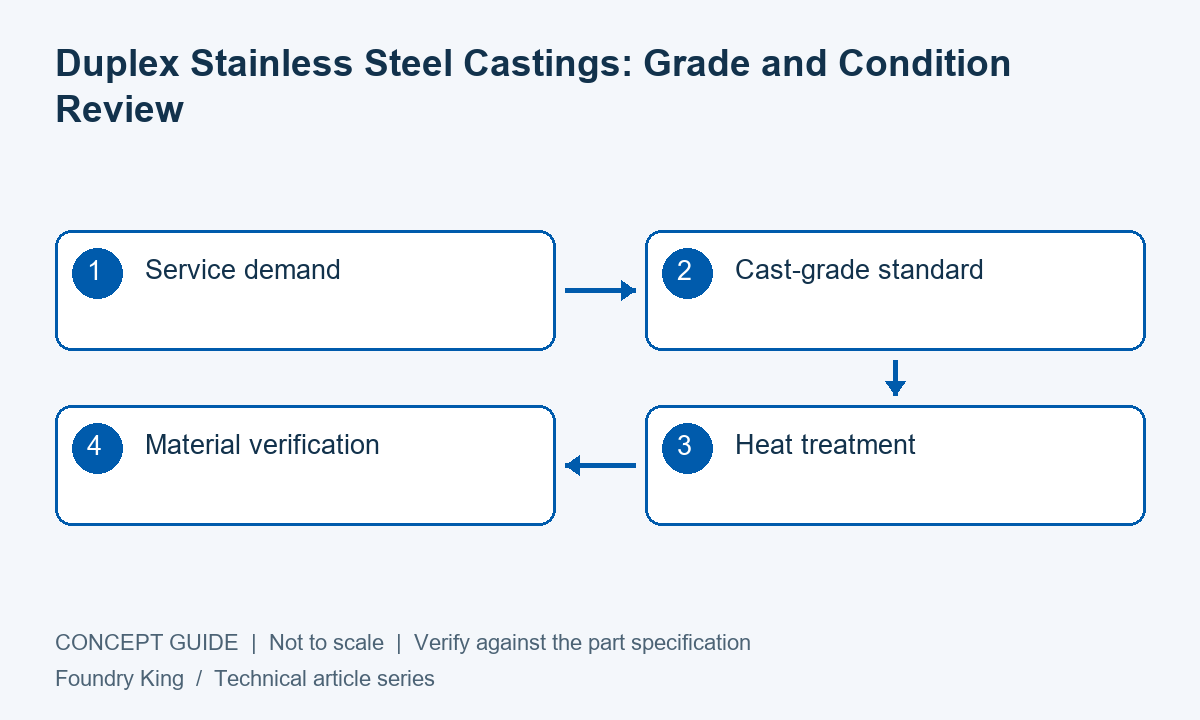
Establish the service requirement
Record the process fluid, temperature, pressure and relevant mechanical loading. Include cleaning, stagnation and crevice conditions where they matter. A grade that suits one wet-service environment may not be suitable for another, even when both are described as corrosive.
Use the equipment designer’s requirements and appropriate material-selection expertise. Avoid assigning universal service limits from a general comparison page. The component’s geometry, joining and operating conditions influence the final decision.
Use the correct product-form specification
Duplex wrought and cast designations are related through alloy families, but their governing specifications and requirements differ. If a drawing names a wrought forging grade, resolve the intended cast material before quotation and production. An equivalence chart is a starting point for review, not automatic approval.
Specify the required casting standard, grade, condition and supplementary tests. Keep these requirements consistent in the drawing, purchase order and certificate. This is particularly important when the part moves through several subcontracted operations.
Review heat treatment and material verification
Processing influences the material structure and performance of duplex castings. The required heat-treatment route and any phase-related acceptance must follow the governing specification and application requirements. Chemical analysis alone does not establish that the material has the intended condition.
Agree what evidence is required, which test methods apply and where samples are taken. Do not substitute a quick screening measurement for a specified material qualification test without technical approval. Different measurements provide different information.
Coordinate integrity and finishing
| Requirement | Review item | Evidence to retain |
|---|---|---|
| Material identity | Cast grade and product-form standard | Heat-linked material certificate |
| Material condition | Specified processing and supplementary tests | Treatment and test reports |
| Component integrity | Critical regions and applicable acceptance | Traceable examination results |
Control fabrication and repair
Welding, repair and surface finishing require procedures appropriate to the actual grade and specification. Discuss restrictions before production and obtain approval where required. A successful visual repair does not establish that the material condition remains acceptable.
For repeat supply, retain the approved route and require review of significant changes. Duplex castings should be purchased as controlled engineering products, not as generic upgrades to every stainless component. A clear specification makes supplier comparisons more reliable and prevents undocumented substitutions.
Frequently asked questions
Is 2205 a complete casting specification?
No. It describes an alloy family context; the actual cast grade, standard, condition and tests must be identified.
Does a chemistry result prove the phase condition is acceptable?
Not by itself. Use the processing and verification requirements specified for the application.
Discuss your component requirements
For related information, review stainless steel casting information, or discuss a duplex casting specification. Include the drawing revision, alloy, quantities and critical acceptance requirements so the proposed route can be reviewed against the actual part.

Get Premium Casting Products
Join foundryking.com Newsletter to get more information of different premium OEM Casting products in China.


