

 By Coco
Consider local thermal history rather than describing the whole casting as cooling at one rate.
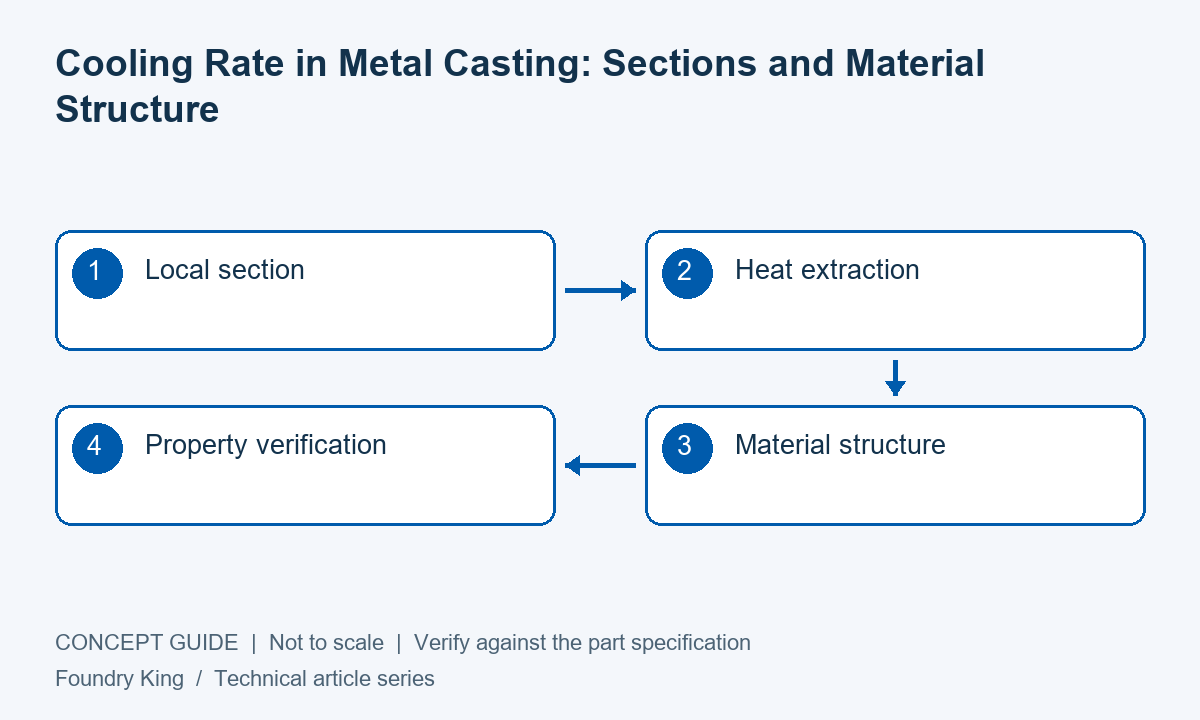
Cooling rate in metal casting varies across a component. A thin rib, a thick boss and a junction surrounded by other hot sections do not share the same thermal history. Those differences can affect solidification, feeding and material structure, so process review should consider local geometry rather than a single cooling-rate label for the entire part.
Understand the role of section thickness
Heat must leave the metal through the surrounding mold and other available paths. Heavy sections generally behave differently from thin features, and adjacent masses can change a region’s effective thermal environment. A local increase in thickness may therefore create a new last-to-solidify region.
This is one reason gradual transitions and thoughtful junction design matter. Improving structural strength by adding material can also complicate feeding. The designer and foundry should review the trade-off together before treating a thicker wall as an uncomplicated improvement.
Include mold and process conditions
Mold material, thermal condition, cores and local chilling influence heat extraction. The same nominal part poured using different routes may not develop identical local conditions. Cooling behavior must therefore be assessed with the intended alloy and production method.
Avoid universal claims that faster cooling always produces a better casting. The desired structure and properties depend on the alloy and application. A local condition that helps one requirement may increase another risk or make machining more difficult.
Distinguish casting cooling from heat treatment
Solidification establishes an initial structure and defect condition. Later heat treatment can modify some material characteristics but does not erase every discontinuity created during casting. A shrinkage cavity, for example, is not automatically removed by a normal heat-treatment cycle.
When properties are required, specify the applicable grade, delivery condition and testing. Do not use a heat-treatment description as a substitute for a complete material specification. Dimensions may also need rechecking after processing that can cause movement.
Review evidence at the right location
| Concern | Thermal question | Useful evidence |
|---|---|---|
| Heavy junction | Does it retain a viable feeding path? | Method review and targeted integrity checks |
| Machining difficulty | Is local structure or hardness different? | Relevant material and hardness examination |
| Required properties | What condition does the specification govern? | Traceable test results and treatment records |
Use a controlled trial for changes
If a chill, mold change or altered cooling practice is proposed, define what the trial must demonstrate. Inspect the original problem region and check for new effects elsewhere. A local improvement can change feeding or residual stresses in another part of the component.
Record the final method and material condition once approval is complete. For repeat orders, this baseline supports investigation if dimensions, hardness or soundness drift. Thermal control is part of a complete manufacturing route rather than a single setting that can be copied between unrelated castings.
Frequently asked questions
Does rapid cooling always increase useful strength?
No. The response depends on alloy, structure and required condition, and other properties may be affected.
Can heat treatment compensate for poor feeding?
It cannot be assumed to remove shrinkage defects. Feeding and material condition require separate control and acceptance.
Discuss your component requirements
For related information, review cast steel materials, or discuss thermal and property requirements. Include the drawing revision, alloy, quantities and critical acceptance requirements so the proposed route can be reviewed against the actual part.

Get Premium Casting Products
Join foundryking.com Newsletter to get more information of different premium OEM Casting products in China.


