

 By Coco
Match a constant-section material form to the part you need to machine.
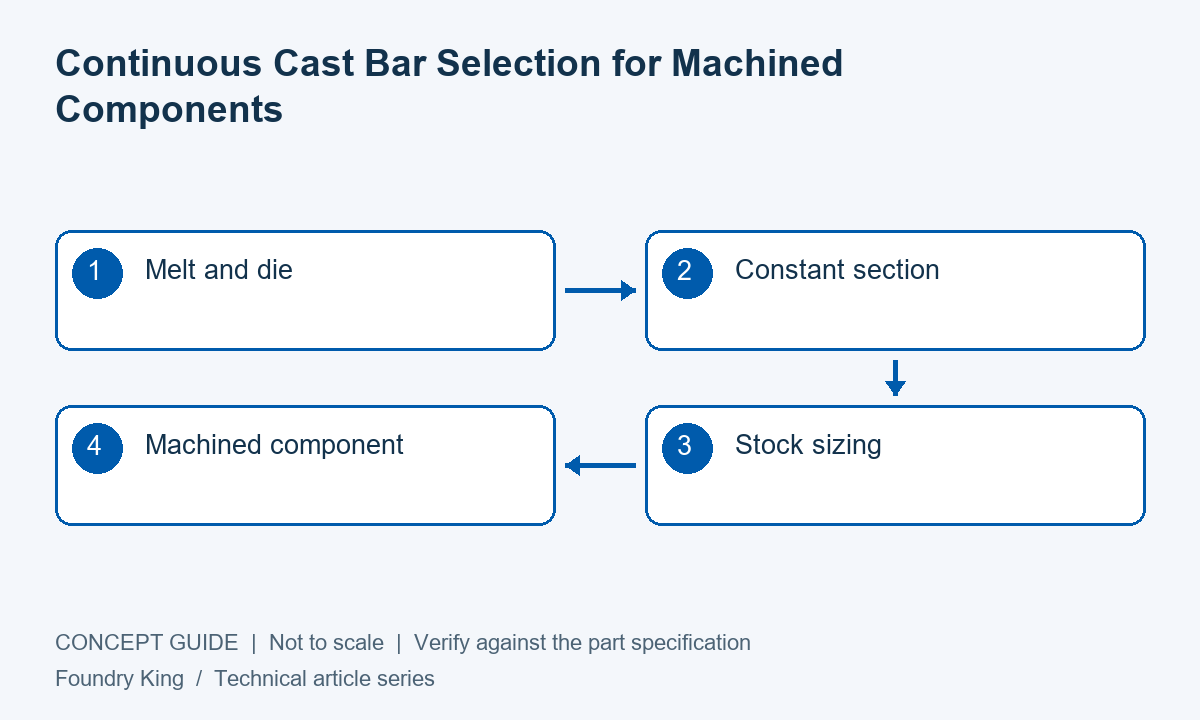
Continuous cast bar can provide a useful starting form for machined components when a constant cross-section suits the production plan. It should not be confused with a custom near-net-shape casting. The right choice depends on the finished envelope, metal removal, grade availability, internal quality and the number of parts required.
Separate material form from alloy grade
The process describes how the stock is made; the grade establishes the required material properties and condition. A bronze bar, for example, needs an actual alloy specification rather than merely the word bronze. Similarly, cast iron grades differ in graphite structure, matrix and mechanical requirements.
Provide the standard, grade, delivery condition and any supplementary requirements. If a supplier proposes an alternative designation, assess chemistry, properties and testing separately. Similar trade names do not prove that two materials are interchangeable in a bearing, pressure component or safety-related assembly.
Calculate the usable machining envelope
The stock must contain the complete finished part after surface cleanup, straightness effects and workholding are considered. A nominal bar diameter equal to a finished diameter normally leaves no room for cleanup. The appropriate allowance depends on supplied condition and process capability, so confirm it with the material supplier and machinist.
For rectangular sections, include corner cleanup and the way the component will be referenced in its fixture. Cutting multiple parts from one length also requires saw kerf and end allowances. Compare quotations using usable component yield rather than the lowest price per kilogram of stock.
Compare bar stock with custom casting
Bar stock may avoid dedicated shape tooling and can suit changing designs or low demand. However, a complex housing machined from a large solid section can create extensive waste, long cycles and difficult access to internal passages. A custom casting may reduce removal while adding tooling and first-article development.
Make that comparison with actual geometry and quantities. Do not assume that continuous casting always offers the cheapest route, or that a shaped casting always saves money. Tooling, scrap recovery, machining time, inspection and stock availability all affect the decision.
Review the purchase specification
| Decision | Information needed | Potential consequence |
|---|---|---|
| Grade | Material standard and required condition | Incorrect wear, strength or corrosion behavior |
| Section | Finished envelope plus machining stock | Insufficient cleanup or excess waste |
| Length | Cut plan and workholding allowance | Poor yield or unexpected additional purchases |
Carry identification through machining
Record the supplied material identity and maintain traceability when a bar is divided. If testing is required, agree whether it applies to the heat, a representative product section or the finished component. Those are different forms of evidence and should not be treated as equivalent without review.
Inspect the first machining run for material-related defects and confirm whether the selected stock size is efficient. Feedback from the machinist can improve later orders, especially where a smaller stock section, different cut length or alternate delivery condition could reduce waste without compromising acceptance.
Frequently asked questions
Is continuous cast bar a wrought product?
No. The stock is produced by solidification. Do not automatically apply wrought-product properties or specifications to a cast bar.
Is a material certificate enough for every application?
It verifies the information it actually records. Additional dimensional, integrity or application-specific checks may still be needed.
Discuss your component requirements
For related information, review compare iron and aluminum components, or review material and component requirements. Include the drawing revision, alloy, quantities and critical acceptance requirements so the proposed route can be reviewed against the actual part.

Get Premium Casting Products
Join foundryking.com Newsletter to get more information of different premium OEM Casting products in China.


