

 By Coco
Distinguish incomplete filling from an unbonded meeting of metal fronts.
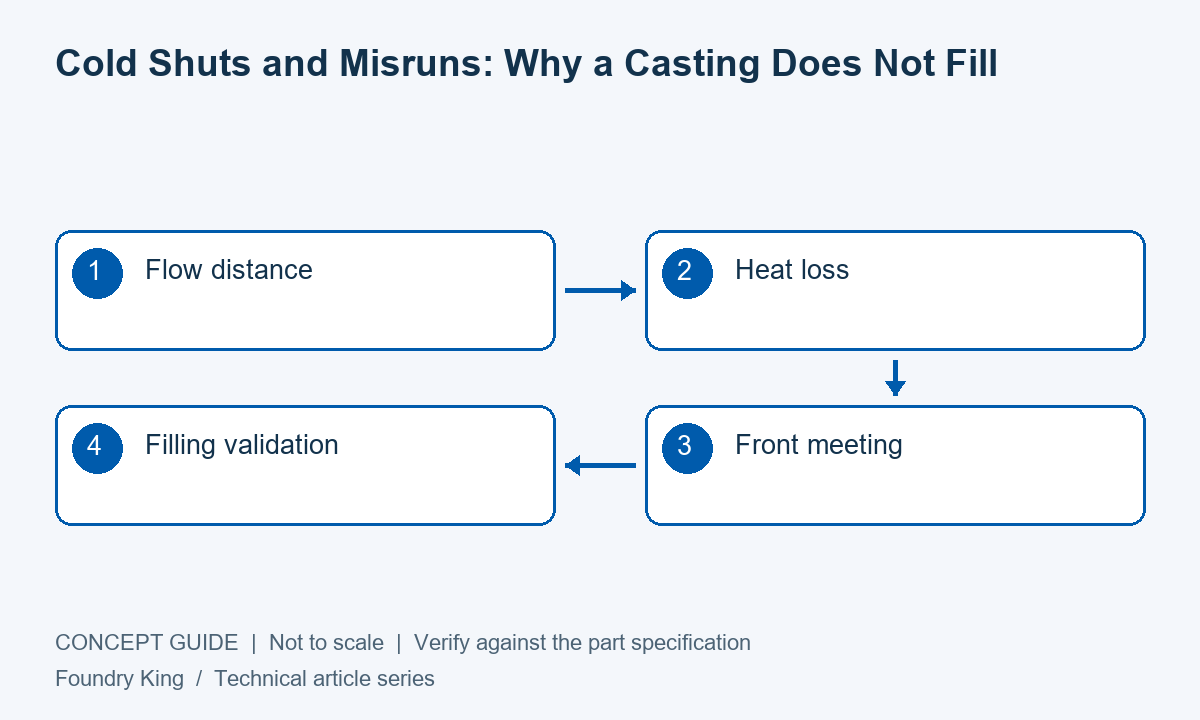
Cold shuts and misruns are filling-related casting defects with different appearances and implications. A misrun leaves an incompletely formed region. A cold shut can appear where metal fronts meet without properly fusing. Both deserve a review of the filling conditions and geometry rather than an automatic instruction to increase pouring temperature.
Document the incomplete feature
Mark the affected region on the drawing and photograph both sides where accessible. Record whether the feature is consistently incomplete or varies between parts. A repeated thin edge and an isolated short fill may point to different conditions.
Distinguish these defects from damage during handling or finishing. A broken edge after shakeout does not have the same mechanism as a region never filled with metal. Preserving the as-found condition helps avoid an investigation based on an incorrect defect name.
Review the metal’s route to the feature
Long flow paths and thin sections lose heat differently from short, thick features. Gate location, flow splits and remote extremities can therefore determine which area fills last. Evaluate the proposed path with the foundry rather than judging feasibility from wall thickness alone.
The mold’s thermal condition and the chosen alloy also matter. A route that fills a particular geometry in one material may not fill it reliably in another. Do not copy a pouring condition from an unrelated casting as a substitute for process development.
Consider venting and flow-front behavior
Air and gases need a suitable escape path as metal enters the cavity. Poor venting can obstruct filling or contribute to other defects. Increasing pressure or temperature without understanding the obstruction may shift the problem rather than remove it.
Where separate metal fronts meet, review their timing, temperature and surface condition. Simulation may help compare flow paths, but it must use representative inputs and be validated against cast results. A visually complete computer model is not proof that a real production part will be acceptable.
Control the correction trial
| Change under review | Potential benefit | Risk to check |
|---|---|---|
| Gate arrangement | Shorter or more balanced filling path | Turbulence, inclusions and feeding effects |
| Section transition | Improved flow continuity | Changed stiffness or functional geometry |
| Thermal conditions | More available filling time | Surface reaction, gas or other quality effects |
Confirm the defect is truly removed
Inspect the formerly affected region using methods suited to the suspected discontinuity. A cold shut may remain as a seam even when the outer shape looks complete. Acceptance must address integrity as well as dimensional completion.
Retain the approved change and update tooling or process documents. If the customer geometry changes, record the revision explicitly. Controlled improvement prevents a temporary workshop adjustment from becoming an undocumented difference between initial and repeat orders.
Frequently asked questions
Is higher pouring temperature always the correct fix?
No. Gate design, venting, geometry and process conditions interact, and excessive temperature can create other problems.
Can a cold shut be accepted because the part measures correctly?
Dimensional conformity does not establish integrity. Evaluate the discontinuity against the component’s specified acceptance criteria.
Discuss your component requirements
For related information, review investment cast component requirements, or discuss a filling-related defect. Include the drawing revision, alloy, quantities and critical acceptance requirements so the proposed route can be reviewed against the actual part.

Get Premium Casting Products
Join foundryking.com Newsletter to get more information of different premium OEM Casting products in China.


