

 By Coco
Use cast-grade requirements and the real exposure conditions when choosing stainless steel.
CF8 vs CF8M is a practical comparison for cast stainless components exposed to liquids and industrial environments. These are cast-grade designations, not simply alternate names for every product sold as 304 or 316. Selection should consider the governing material specification, service fluid, temperature, surface condition and customer acceptance requirements.
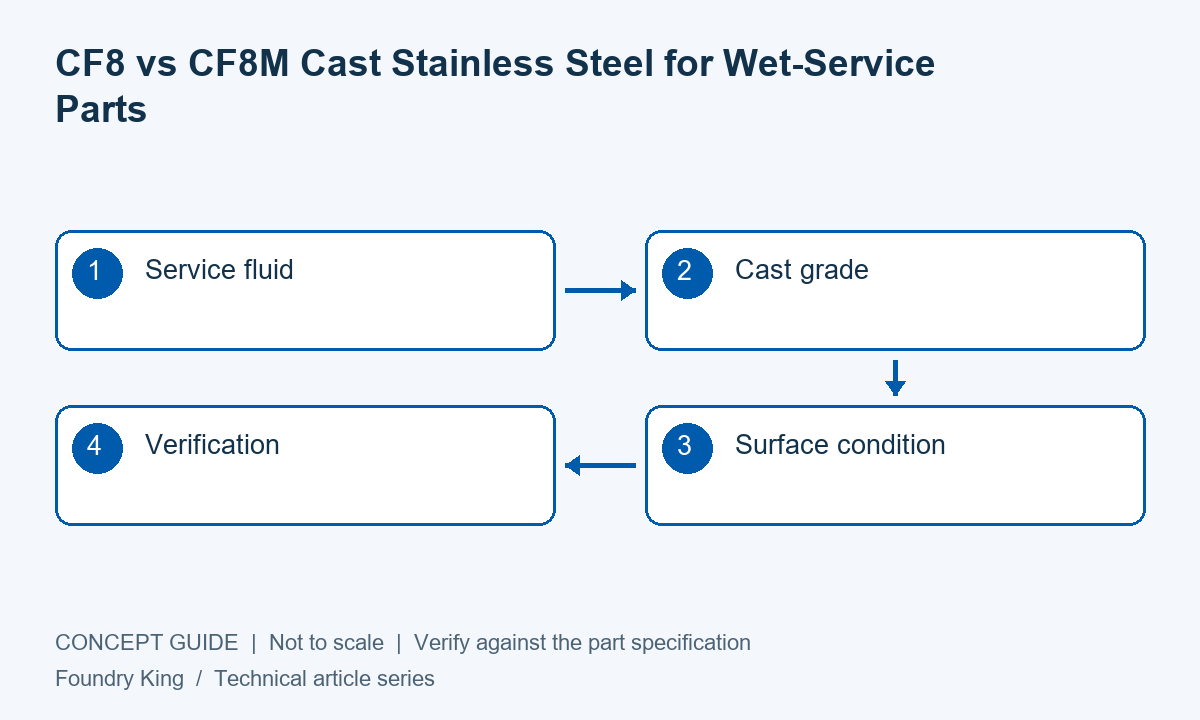
Describe the environment clearly
Provide the fluid composition and relevant contaminants, operating temperature, cleaning chemicals and whether stagnant conditions or crevices are likely. Corrosion performance can change with these factors. The word stainless does not mean a casting is immune to every industrial liquid.
Molybdenum-bearing stainless families are often considered where certain corrosion conditions make them useful, but no simple grade comparison replaces a service assessment. Avoid assigning a universal chloride limit or guaranteed life without application-specific evidence.
Specify the casting material correctly
Use the required cast-grade standard and condition on the purchase order. Common wrought-family comparisons can help explain broad alloy relationships, but the casting specification governs chemistry, properties, processing and test evidence.
If a drawing uses a wrought designation for a casting, resolve the intended cast requirement before production. Do not let the foundry make an undocumented substitution based only on a familiar equivalence table. The approved specification should remain consistent across the drawing, quotation and certificate.
Review surface and finishing conditions
Rough surfaces, embedded contamination and inaccessible crevices can affect service behavior. Define the required cleaning and any specified surface treatment in relation to the application. A polished exterior is not proof that internal passages have the same condition or cleanliness.
For machined sealing areas, include dimensional and surface requirements along with integrity acceptance. Material chemistry and casting soundness are different subjects. A correct grade does not eliminate the need for relevant examination or a specified leak test.
Compare purchasing evidence
| Requirement | Clarify before ordering | Avoid relying on |
|---|---|---|
| Corrosion duty | Fluid, temperature and cleaning conditions | The word stainless alone |
| Material identity | Casting standard, grade and condition | A loose 304/316 substitution |
| Quality | Inspection stage and acceptance criteria | Appearance as proof of soundness |
Evaluate the complete component
Consider mating materials, gaskets and installation conditions as well as the casting. A crevice created during assembly may affect a material that performed well in a simpler test environment. Where the duty is critical, obtain appropriate material-selection input from the equipment designer or corrosion specialist.
Record the approved grade and finishing route for repeat orders. A later substitution or change in surface processing should be reviewed against the original service requirements. That keeps the material decision connected to the actual application rather than a purchasing shorthand.
Frequently asked questions
Is CF8M automatically suitable for seawater?
No. Seawater duty depends on temperature, flow, crevices and other conditions. The complete application needs a specific material assessment.
Can a 316 bar certificate be used as a casting certificate?
No. The supplied casting must meet its specified product-form and testing requirements.
Discuss your component requirements
For related information, review stainless steel cast components, or discuss the fluid and material specification. Include the drawing revision, alloy, quantities and critical acceptance requirements so the proposed route can be reviewed against the actual part.

Get Premium Casting Products
Join foundryking.com Newsletter to get more information of different premium OEM Casting products in China.


