

 By Coco
Use simulation to test an engineering question, not as a decorative approval image.
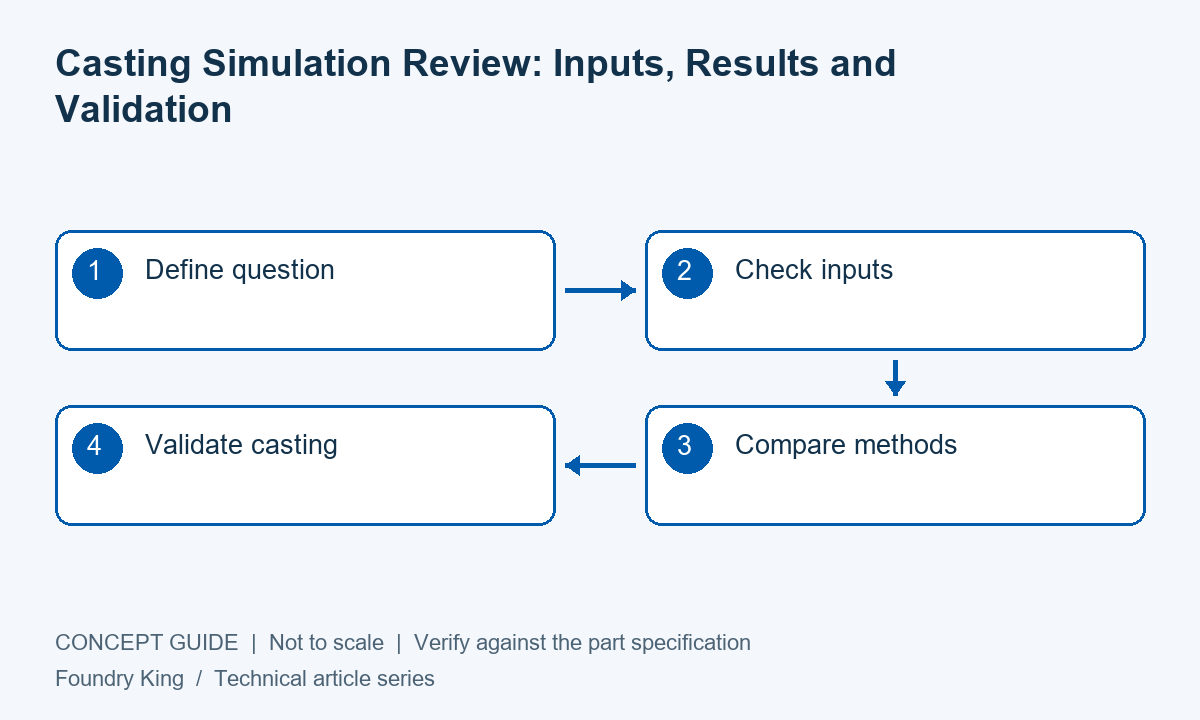
A casting simulation review should explain a manufacturing decision. The model may investigate a difficult fill, an isolated hot spot or a change in feeding arrangement. Its value depends on representative inputs, technically sound interpretation and comparison with real castings. Attractive graphics alone do not prove that production will meet the drawing.
State the question being tested
Identify the failure risk or design choice before examining results. A model created to compare filling alternatives does not automatically qualify every dimensional or material requirement. Define which region and mechanism the analysis is intended to address.
Where the design is being optimized, retain the original and revised versions. Document what changed and why. Otherwise, a successful result may be associated with a model that no longer matches the released part or the production tooling.
Review the input basis
The geometry should include the relevant cavity, gates, risers and cores. Material properties and thermal boundary conditions need to suit the alloy and process. Simplifications may be appropriate, but they should be understood where they influence the question being investigated.
Ask whether pouring conditions and mold behavior reflect the intended production route. An analysis based on idealized conditions can support learning without proving a robust operating window. The responsible engineer should explain the limitations instead of presenting every result as a guarantee.
Separate prediction from acceptance
Filling results can help compare flow paths, front meeting and trapped regions. Solidification results can highlight thermal behavior and potential feeding difficulties. These outputs guide method decisions but do not replace the component’s specified acceptance tests.
If a defect-prediction criterion is used, ask how it has been interpreted and validated for the alloy and type of component. Different indicators are not interchangeable. A low predicted risk in a color map does not authorize relaxing a drawing requirement without customer approval.
Ask for a concise decision record
| Review element | Useful record | Why it matters |
|---|---|---|
| Model revision | Part and method identities | Connects analysis to production tooling |
| Comparison | Original and proposed arrangement | Shows what the simulation changed |
| Validation | Actual sample inspection results | Checks prediction against reality |
Close the loop with production
Inspect representative samples at the regions the analysis identified as important. Where sectioning or volumetric examination is used, align it with the investigation objective. Compare the results with the predicted behavior and update the method where necessary.
For repeat orders, preserve the approved method and relevant process limits. If the foundry changes the gate, riser, core or pouring arrangement, assess whether the previous analysis still applies. Simulation is most valuable when connected to controlled manufacturing, not filed separately as a one-time sales document.
Frequently asked questions
Can simulation guarantee a defect-free casting?
No. It supports engineering decisions within its assumptions and must be combined with process control and appropriate verification.
Must every simple casting have a simulation report?
Not necessarily. The need depends on risk, complexity, development uncertainty and the agreed quality plan.
Discuss your component requirements
For related information, review precision cast component information, or discuss a simulation-supported design review. Include the drawing revision, alloy, quantities and critical acceptance requirements so the proposed route can be reviewed against the actual part.

Get Premium Casting Products
Join foundryking.com Newsletter to get more information of different premium OEM Casting products in China.


