

 By Coco
Define what the examination needs to find before ordering “100% NDT.”
Casting nondestructive testing is not one interchangeable test. Penetrant, magnetic particle, ultrasonic and radiographic examinations respond to different discontinuities and have different limitations. A useful specification identifies the material, regions, production stage and acceptance criteria so the selected method can demonstrate what the component actually requires.
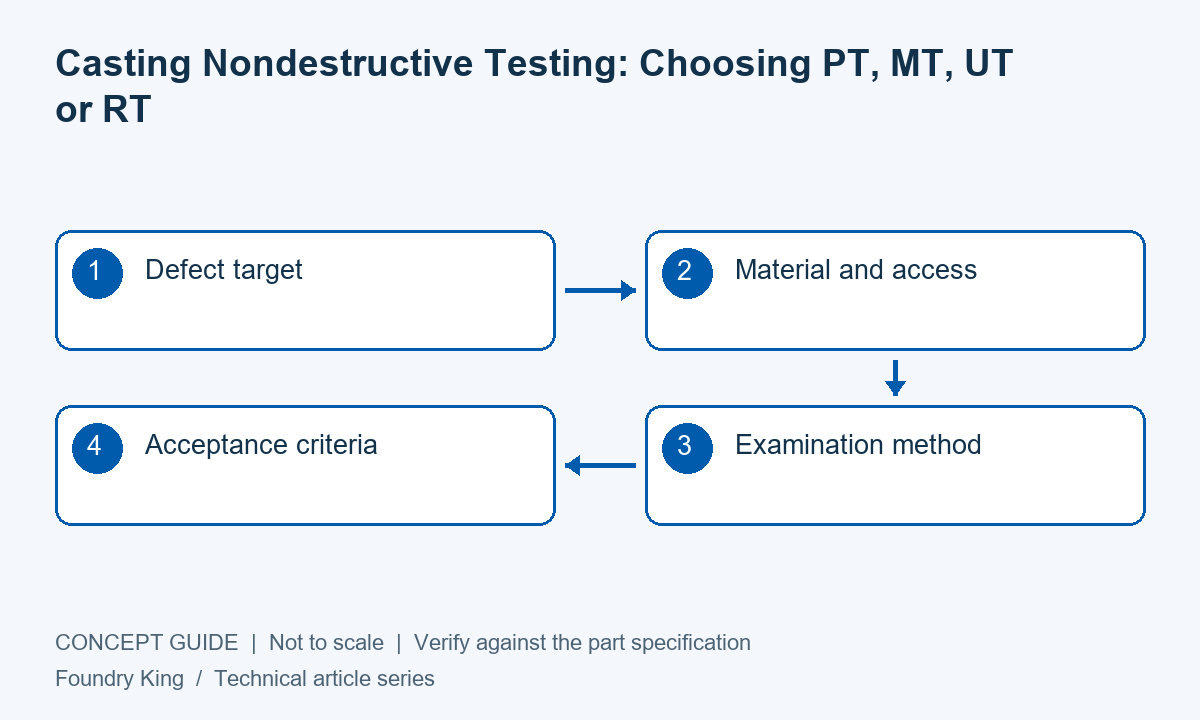
Define surface and internal targets
Surface-connected cracks require a different detection strategy from internal cavities. The relevant region may be a machined sealing face, a highly stressed transition or a heavy section. Identify these areas on the drawing rather than assuming complete coverage has an obvious meaning.
Consider the condition of the surface at the time of testing. Roughness, coatings, contamination and access can affect a method’s effectiveness. A test performed before machining may not evaluate the final exposed surface, so sequence matters.
Understand the main methods
Liquid penetrant testing can reveal discontinuities open to the surface on suitable nonporous materials. Magnetic particle testing relies on magnetization and is limited to ferromagnetic materials. Neither method is a general replacement for internal examination, and each needs a defined procedure and surface condition.
Ultrasonic testing uses sound and can be affected by geometry, grain structure and access. Radiography records differences in transmitted radiation and has its own sensitivity to defect orientation and section geometry. Qualified technical personnel should select and interpret the method for the actual material and part.
Specify coverage and criteria
A purchase order stating “NDT certificate required” leaves the examined area and acceptance level unresolved. Define the governing standard or customer specification, procedure, qualification requirements and reporting. If sampling is allowed, state how samples are selected and what triggers further examination.
The presence of an indication does not automatically establish rejection. Acceptance depends on the specified type, size, location and distribution. Conversely, an absence of reported indications is meaningful only within the capability and coverage of the examination performed.
Match method to the question
| Method | Typical examination focus | Important limitation to review |
|---|---|---|
| PT | Surface-opening discontinuities | Requires suitable surface preparation and access |
| MT | Surface and near-surface indications in suitable materials | Material must support magnetization |
| UT | Internal sound-path examination | Geometry and structure can limit interpretation |
| RT | Internal density-related indications | Orientation, section and access affect sensitivity |
Plan reporting and repair approval
Reports should connect the part identity, examined regions, method and acceptance result. If an indication is removed or repaired, record the disposition and the required re-examination. Do not allow an unrecorded repair to break traceability between the original finding and delivered condition.
NDT complements material verification, dimensions and functional tests; it does not replace them. A casting may pass a specified examination while still having the wrong alloy or an out-of-tolerance bore. Build the complete inspection plan around the component’s duty.
Frequently asked questions
Is radiography always better than ultrasound?
No. Suitability depends on material, geometry, discontinuity type and required sensitivity. The methods answer different questions.
Does “100% tested” prove a casting has no defects?
It states a coverage intention, not unlimited detection. The method, procedure, sensitivity and acceptance criteria remain essential.
Discuss your component requirements
For related information, review steel casting applications, or define an inspection scope. Include the drawing revision, alloy, quantities and critical acceptance requirements so the proposed route can be reviewed against the actual part.

Get Premium Casting Products
Join foundryking.com Newsletter to get more information of different premium OEM Casting products in China.


