

 By Coco
Give metal a controlled route into the mold and a viable feeding path as it freezes.
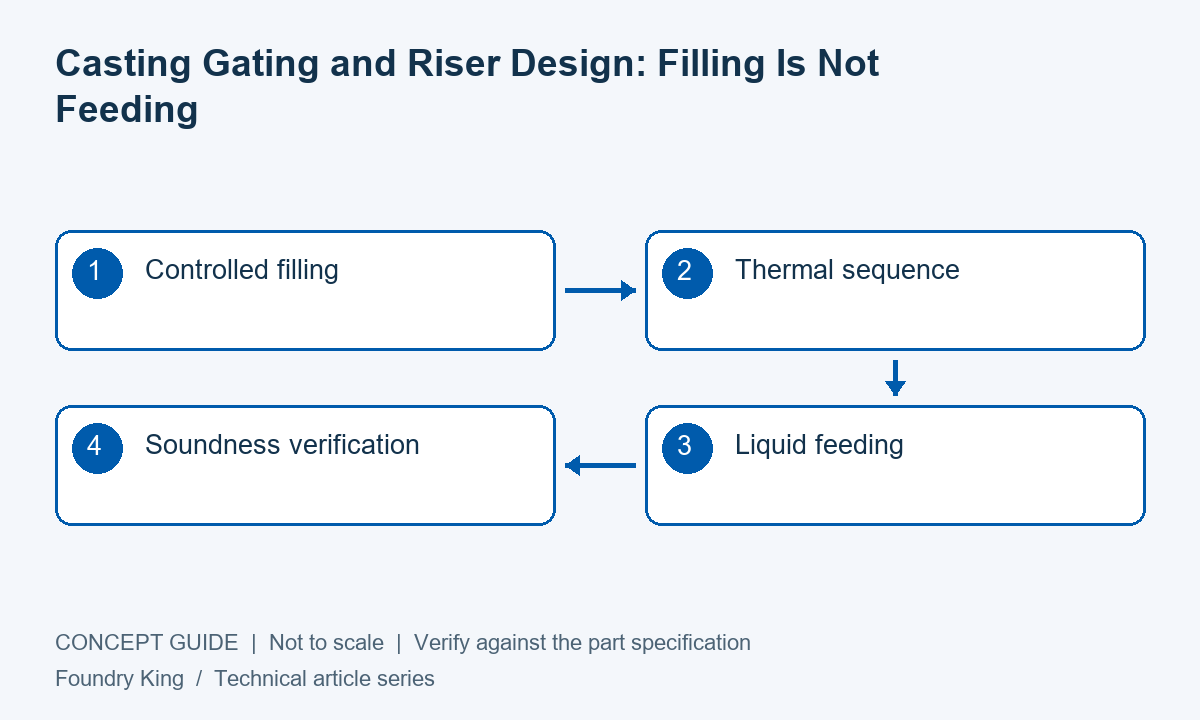
Casting gating and riser design addresses two related but different problems. The gating system distributes molten metal into the mold; risers provide a reservoir and feeding arrangement during solidification. A cavity can fill completely yet still develop shrinkage if a heavy region loses its liquid feed too early.
Define the filling objective
Sprues, runners and ingates influence flow direction, velocity and the way air and inclusions interact with the incoming metal. The arrangement must fill the required geometry while controlling harmful turbulence and erosion. A larger gate is not automatically an improvement if it changes the flow pattern unfavorably.
Review thin extensions and remote features together with the main body. If several fronts meet, their condition and timing matter. The alloy, mold and pouring conditions affect this behavior, so a gate proportion used successfully on one component is not a universal design rule.
Identify the feeding requirement
Solidifying metal changes volume, and some regions need continued access to liquid feed. Heavy junctions and isolated masses deserve attention because they can solidify later than connecting sections. A reservoir that freezes too soon or loses its connection cannot perform its intended role.
The method may use risers, chills, geometry changes and other foundry techniques to influence the thermal sequence. These choices require alloy-specific engineering. The buyer should understand the acceptance objective and review functional effects without prescribing an unsupported workshop recipe.
Coordinate gate removal and machining
Gates and risers eventually have to be removed. Their location can influence cutting, blending, heat input and machining access. Do not place an important sealing or fatigue-sensitive surface at risk merely to simplify an early method sketch.
Mark acceptable witness areas and the required finished envelope. If local blending is permitted, specify how the remaining section is controlled. That turns finishing from a cosmetic judgment into a defined part of the production plan.
Examine method-development evidence
| Question | Relevant method feature | Verification direction |
|---|---|---|
| Does the cavity fill? | Gates, flow path and venting | Representative casting or validated filling study |
| Can heavy regions be fed? | Riser connection and thermal sequence | Targeted soundness examination |
| Can the part be finished? | Cutoff and access locations | Finished sample and dimensional checks |
Validate the method against cast results
Simulation can compare alternatives, but its assumptions must represent the process. Review geometry, material data, boundary conditions and how the result is checked against actual castings. A color plot without interpretation or validation is weak evidence for a critical component.
When an improvement is approved, control the method drawing and tooling changes. Record the relationship between method revision and the sample results. If a later production problem occurs, this provides a baseline for investigation rather than forcing the team to reconstruct how the original sample was made.
Frequently asked questions
Can a larger riser fix every shrinkage defect?
No. Feeding depends on the thermal sequence and an effective connection as well as reservoir capacity.
Is a fully filled casting necessarily internally sound?
No. Filling and feeding are distinct requirements, and appropriate integrity checks may still be needed.
Discuss your component requirements
For related information, review steel casting requirements, or discuss a casting method review. Include the drawing revision, alloy, quantities and critical acceptance requirements so the proposed route can be reviewed against the actual part.

Get Premium Casting Products
Join foundryking.com Newsletter to get more information of different premium OEM Casting products in China.


