

 By Coco
Make impact and failure consequences part of the material-selection discussion.
Cast steel vs ductile iron becomes an important decision when a component experiences shock, variable loading or an uncertain service environment. Tensile strength is only one part of that decision. Toughness, ductility, temperature, section geometry and allowable defects may determine whether a grade is suitable for the actual duty.
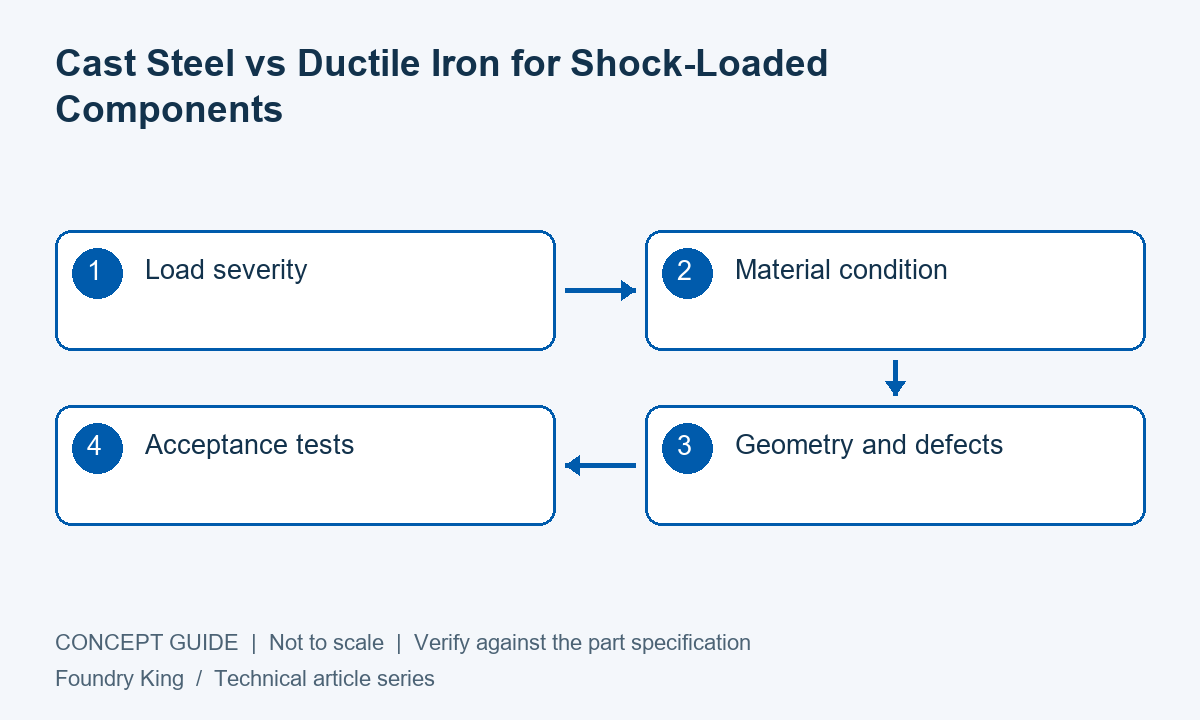
Describe the loading realistically
A slowly applied load and a sudden impact can demand different material behavior. Include the likely temperature, load direction and frequency, together with any overload or abuse conditions the design must address. A purchasing specification based only on a minimum strength can miss these important differences.
Identify the consequence of failure. A replaceable wear component may have a different acceptance strategy from a load-carrying support whose fracture could damage equipment or injure people. The designer and applicable requirements should establish the needed evidence, not the supplier’s marketing description.
Compare specific grades and conditions
Ductile iron uses nodular graphite within an iron matrix; cast steels use different chemistry and microstructural routes. Properties vary within both families and with the specified processing condition. An annealed grade and a heat-treated high-strength grade should not be compared as though they represent every casting in that family.
Where impact properties are required, specify the relevant test conditions and acceptance basis. Do not infer toughness from tensile strength or hardness alone. Material certificates should identify what was actually tested and how that evidence relates to the supplied castings.
Consider the geometry and defect sensitivity
Sharp transitions, abrupt thickness changes and heavy junctions influence stress and casting soundness. A stronger nominal material does not correct an unfavorable design. Review radii, load paths, feeding and the location of machined surfaces before deciding that a material change will solve a failure problem.
Inspection must target the regions and discontinuities relevant to the application. Methods have different capabilities and limitations, and acceptance criteria must be agreed. “100% inspected” is incomplete without specifying the method, coverage and required result.
Compare a complete production proposal
| Topic | Question to resolve | Avoid assuming |
|---|---|---|
| Grade | Which standard and condition apply? | That all steel or ductile iron has the same properties |
| Impact duty | What temperature and loading matter? | That tensile strength proves toughness |
| Quality | Which regions and defect types are critical? | That visual inspection proves internal soundness |
Include lifecycle requirements
Machining, welding or repair restrictions, wear and corrosion can change the selection. Some repair routes may require special approval or may not be permitted by the customer’s specification. Discuss these before production rather than discovering the restriction after a defect is found.
For a replacement component, investigate the original failure and confirm the drawing’s material basis. A controlled engineering review can establish whether grade, geometry or service conditions need to change. Substituting the apparently stronger material without this work can simply move the failure to another location.
Frequently asked questions
Can hardness alone prove a shock-loaded casting is suitable?
No. Hardness is one measurement and does not replace the required toughness, strength, integrity and application assessment.
Is ductile iron always unsuitable for impact?
No. Suitability depends on grade, temperature, loading and design. Review actual requirements rather than making a blanket exclusion.
Discuss your component requirements
For related information, review cast steel component options, or iron casting options. Include the drawing revision, alloy, quantities and critical acceptance requirements so the proposed route can be reviewed against the actual part.

Get Premium Casting Products
Join foundryking.com Newsletter to get more information of different premium OEM Casting products in China.


