

 By Coco
Evaluate the whole assembly before changing the casting material.
Aluminum vs iron castings is not only a weight comparison. A lighter housing can affect stiffness, thermal movement, bearing alignment and thread design. Iron can suit rigid supports and wear-related requirements, while aluminum may support mass and heat-transfer goals. The correct selection depends on the complete assembly and the specific grade, not simply the base-metal name.
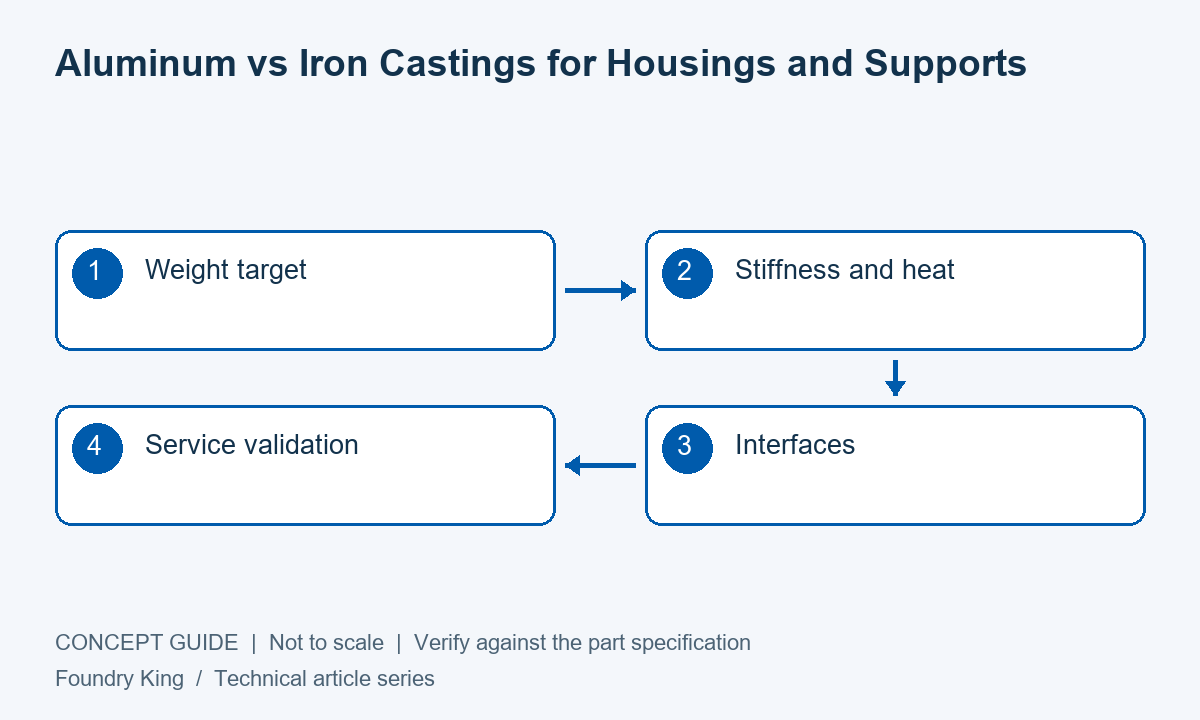
Compare stiffness and geometry together
Material stiffness influences deflection, while section shape determines how the structure resists load. Replacing iron with aluminum at unchanged wall thickness may alter alignment even if the new alloy has adequate tensile strength. A redesign may require ribs, larger sections or different mounting features.
Include the surrounding components in the review. A housing that deflects changes bearing or gear conditions; a bracket with a different resonance can influence vibration. These are equipment-design questions that should be evaluated before a foundry quotation is treated as a complete conversion approval.
Review thermal and environmental conditions
Operating temperature and differential expansion matter for bearing fits, bolted joints and sealing surfaces. Consider the materials on both sides of an interface and how the assembly moves during heating and cooling. A room-temperature dimensional pass does not prove that a fit remains correct in service.
Corrosion also depends on exposure and contact with other metals. Coatings, drainage and galvanic compatibility may matter as much as the nominal alloy. Specify the service environment and required surface protection rather than expecting a generic aluminum or iron selection to solve every corrosion problem.
Check fastening and machining
Thread engagement, inserts and local bearing pressures may change when the material changes. The revised design should address how fasteners transfer load and how often the assembly is serviced. Reusing the same thread detail without review can undermine an otherwise sensible weight reduction.
Both material families can require machining. Compare stock, tool wear, fixturing and the finished surface requirements. A material that machines readily may still require more removal or a more complex setup, so the economics depend on the complete process.
Build a selection record
| Requirement | What to compare | Evidence needed |
|---|---|---|
| Mass target | Finished geometry and complete assembly | Mass calculation or sample measurement |
| Alignment | Deflection, temperature and interface design | Design analysis and relevant testing |
| Durability | Specific grade, wear and environment | Material and service validation |
Do not substitute grade families loosely
Gray iron and ductile iron are different material families, just as aluminum casting alloys differ from one another. Select a grade and condition before comparing properties. Data for a wrought aluminum alloy should not be assigned to an unrelated cast alloy.
If a redesign is proposed, record the material, geometry, process and acceptance changes together. Approve samples in their finished condition and retain the validation basis for repeat orders. That prevents a useful engineering comparison from becoming an undocumented purchasing substitution.
Frequently asked questions
Is aluminum always cheaper because it is lighter?
No. Alloy price, casting route, tooling, machining and finishing determine cost, and a stiffness-driven redesign may change the mass advantage.
Can ductile iron data be used for gray iron?
No. Specify and evaluate the actual grade and product requirements rather than treating all iron castings as interchangeable.
Discuss your component requirements
For related information, review aluminum casting applications, or iron and aluminum casting families. Include the drawing revision, alloy, quantities and critical acceptance requirements so the proposed route can be reviewed against the actual part.

Get Premium Casting Products
Join foundryking.com Newsletter to get more information of different premium OEM Casting products in China.


