

 By Coco
Resolve ejection, filling and functional-surface risks before committing to the die.
An aluminum die casting design review should establish how the part fills, releases from the die and reaches its final functional condition. A visually attractive model may contain a trapped undercut, an unfeedable local mass or a sealing face that exposes pores during machining. These issues are less expensive to discuss before a production die is built.
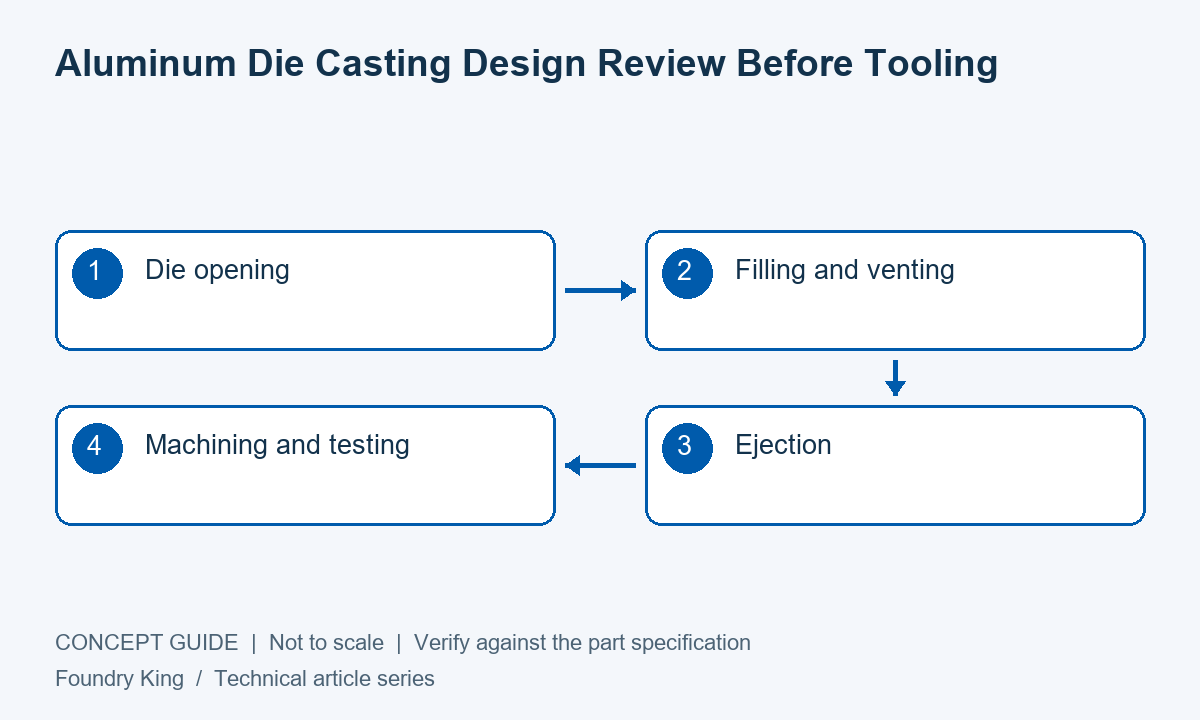
Establish the opening and ejection direction
Review the main die-opening direction, parting line and the need for side actions. Undercuts and cross holes can require slides, additional mechanisms or secondary machining. These choices influence die cost, maintenance and the surfaces on which witness marks may appear.
Ejector-pin locations also matter. They must release the component without unacceptable deformation or damage, and their marks should not interfere with a sealing or appearance requirement. Identify protected surfaces on the drawing and agree where ejector witnesses are permitted.
Review walls and local masses
Relatively consistent sections can help filling and solidification, while abrupt thick bosses create localized thermal behavior. A thicker wall does not automatically make a component more reliable: it can introduce shrinkage risk and extend the process window needed to cool and eject the part.
Use ribs, cored bosses and gradual transitions where appropriate, but assess the complete load path. A manufacturing improvement must still satisfy the mechanical requirement. There is no universal minimum wall thickness that can be promised without considering alloy, flow length, geometry and equipment.
Plan around machining exposure
The cast skin and internal material do not necessarily show the same pore distribution. Machining a sealing face or threaded connection can expose defects that were not visible on the raw part. Specify the machined features early and review whether their location and stock allowance are compatible with integrity requirements.
Where leak tightness matters, define the medium, test stage and acceptance conditions with the equipment designer. A dimensional inspection is not a leak test. Likewise, a process description such as vacuum-assisted die casting is not a substitute for the agreed finished-part acceptance test.
Build a coordinated control plan
| Feature | Tooling discussion | Acceptance discussion |
|---|---|---|
| Undercut | Slide, split line or later machining | Position and remaining wall |
| Sealing face | Machining stock and local fill route | Finish, geometry and leak test |
| Appearance surface | Gate and ejector placement | Permitted witnesses and visual criteria |
Consider finishing compatibility
Coatings, heat treatment and welding need review for the actual alloy and casting route. Conventional high-pressure die castings can present gas-related limitations for some secondary processes. Do not assume that a route suitable for an as-cast bracket will automatically suit a welded or solution-treated assembly.
Before approval, ask for a manufacturing drawing identifying key tooling features and the agreed inspection plan. Evaluate samples in their intended final condition, including machining and specified finishing. That avoids approving a raw casting that later fails the operation the customer actually needs.
Frequently asked questions
Does higher injection pressure guarantee no porosity?
No. Filling pattern, venting, shot control, temperature and geometry interact. Acceptance still needs appropriate evidence.
Is die casting suitable for every steel part converted to aluminum?
No. The material change must address stiffness, temperature, fatigue, corrosion and joining as well as manufacturability.
Discuss your component requirements
For related information, review aluminum die casting components, or submit a die casting design for review. Include the drawing revision, alloy, quantities and critical acceptance requirements so the proposed route can be reviewed against the actual part.

Get Premium Casting Products
Join foundryking.com Newsletter to get more information of different premium OEM Casting products in China.


