

 By Coco
Connect the flow passage, pressure boundary and machined interfaces in one purchase requirement.
Pump casing castings combine internal geometry, material selection and machined interfaces. A casing that looks correct can still have a shifted core, an uncleaned pocket or porosity exposed on a sealing face. Buyers should define the service and acceptance requirements together rather than purchasing only a nominal shape and alloy family.
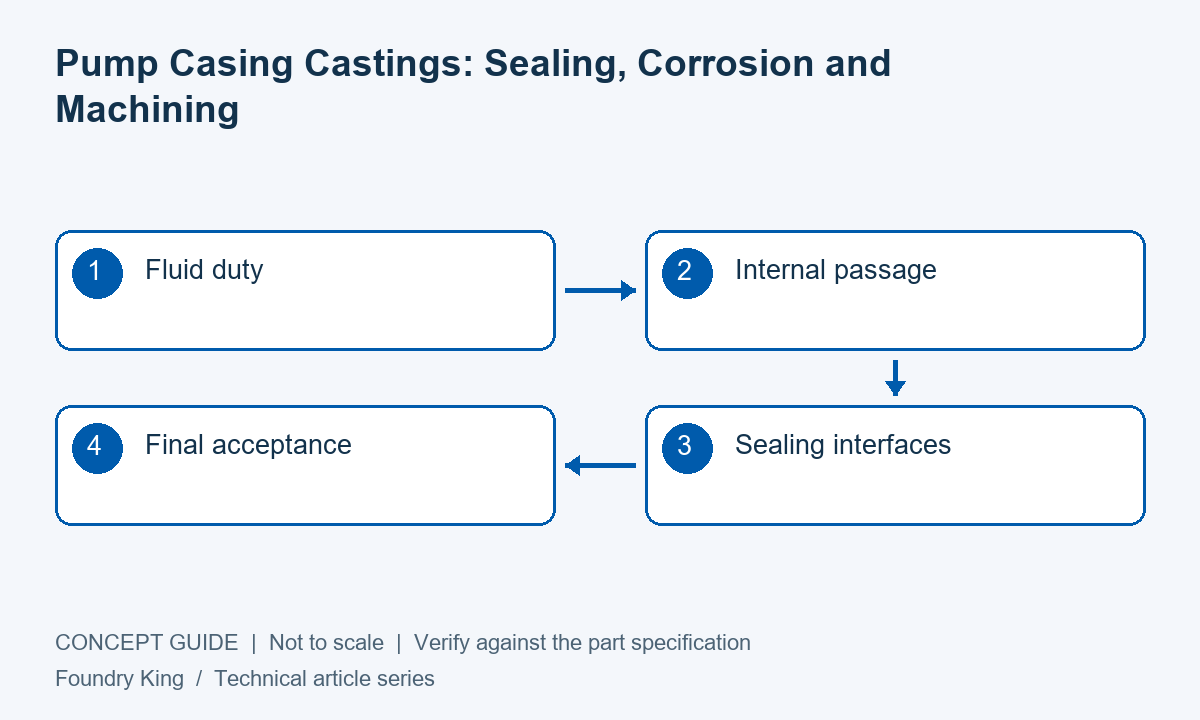
Describe the fluid and operating conditions
Provide relevant fluid chemistry, solids, temperature and mechanical duty. Corrosion, erosion and abrasion can interact, and a material suitable for clean water may not suit a chemically aggressive or abrasive service. The equipment designer should establish the material and design basis.
Avoid selecting from a generic list of pump metals without reviewing the specific grade and condition. Cast iron, steel, stainless and copper alloys each cover multiple materials. The purchase order needs a defined specification and any relevant supplementary requirements.
Review the internal passage
Core location determines wall thickness and flow geometry. Identify where a displacement would affect performance, strength or machining stock. If those features are hidden, agree an appropriate way to verify them on first samples and, where required, production parts.
Internal cleanliness also needs an acceptance basis. Sand, fins or debris can damage downstream equipment or obstruct the intended flow. Discuss cleaning access before tooling; a passage that cannot be cleaned reliably may need a design revision rather than a more forceful cleaning instruction.
Coordinate machining and sealing
Define datums, bearing-related interfaces, flange faces and gasket or seal locations. The foundry needs enough stock to achieve these features without leaving uncleaned areas. Machining can also expose porosity, so review the finished condition rather than accepting only the raw casting.
Identify the required surface texture and geometry at sealing locations. “Smooth” is not an adequate substitute for a drawing requirement. Pressure or leak testing, where required, must follow the agreed procedure and acceptance basis.
Compare quotation scope
| Requirement | Information to provide | Potential omission |
|---|---|---|
| Material | Grade, condition and service | An unspecified corrosion assumption |
| Internal quality | Wall and cleanliness criteria | A check limited to external dimensions |
| Finished interfaces | Datums, stock and surface requirements | Unexpected machining or test costs |
Use a complete sample review
Evaluate material records, dimensional results and relevant integrity or functional tests together. If a deviation is proposed, record its effect on the design and obtain approval before repeat production. A successful assembly fit does not by itself prove internal cleanliness or pressure integrity.
Maintain the approved core and casting method through repeat orders. Changes intended to improve yield can alter the internal passage or local wall. Review significant method changes against the original acceptance plan and preserve traceability to delivered parts.
Frequently asked questions
Can pump performance be approved from casting dimensions alone?
Not necessarily. The complete pump’s hydraulic and mechanical validation is separate from casting dimensional conformity.
Should every pump casing use stainless steel?
No. Material selection depends on fluid, duty, design and cost; a specific grade must be assessed for the application.
Discuss your component requirements
For related information, review steel casting material options, or submit pump casing drawings and service details. Include the drawing revision, alloy, quantities and critical acceptance requirements so the proposed route can be reviewed against the actual part.

Get Premium Casting Products
Join foundryking.com Newsletter to get more information of different premium OEM Casting products in China.


