

 By Coco
Choose a specific copper alloy for the contact conditions and service environment.
Aluminum bronze vs tin bronze castings is a broad comparison between copper-alloy families. Each contains multiple grades with different properties and manufacturing requirements. A bearing sleeve and a valve component can need very different balances of strength, corrosion behavior, wear and machinability, so the family name should only begin the selection process.
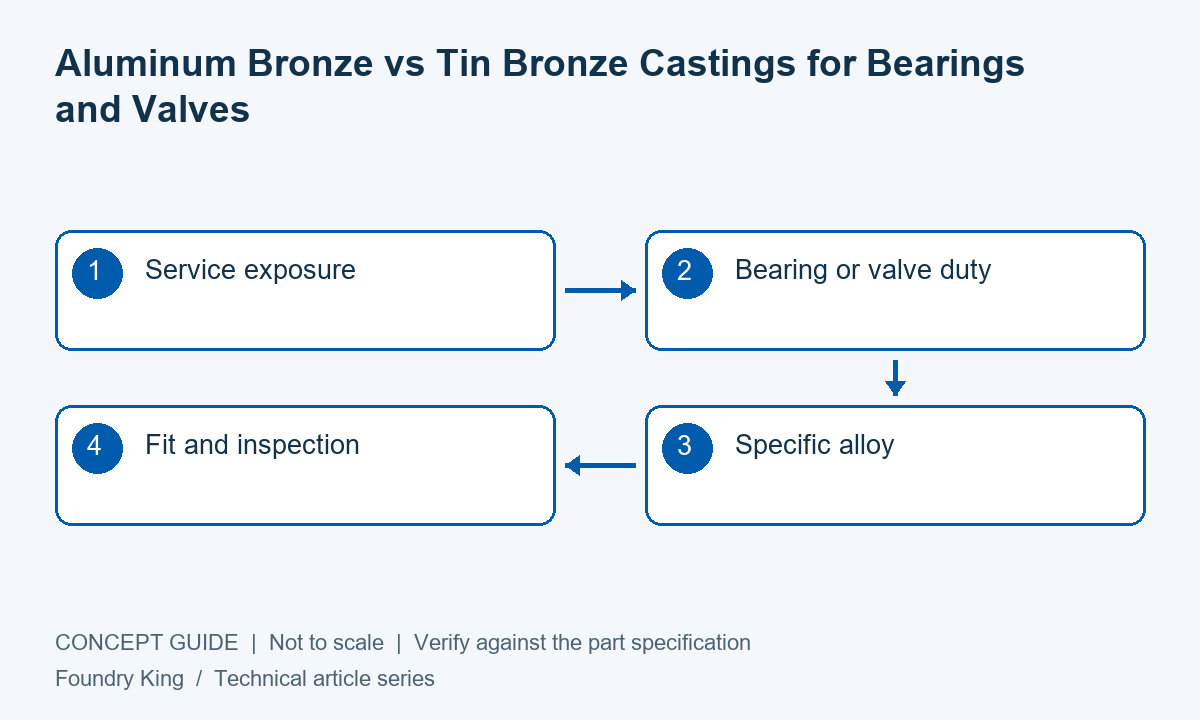
Define whether the part is a bearing
For a sliding component, provide load, speed, motion type and lubrication conditions. Include starts, stops, contamination and the material of the mating surface. The performance of a bearing alloy depends on the system, not only the strength of the sleeve material.
Do not prescribe operating clearances or lubrication from a generic alloy comparison. These depend on the bearing design and service. The equipment designer should define the fit and operating requirements, with material specialists supporting the alloy choice where needed.
Review exposure and grade identity
Corrosion behavior depends on the actual fluid, temperature, flow and crevice conditions. Different bronze grades can suit different environments, but no broad family label establishes universal seawater or chemical compatibility. Specify the service and select a defined grade.
Use the applicable product-form standard and delivery condition. Cast and wrought copper-alloy designations or trade names should not be substituted without review. Where regulatory requirements apply to fluid contact, include them explicitly instead of assuming every bronze grade is acceptable.
Coordinate manufacture and machining
The selected alloy influences foundry practice, machining and finishing. Explain which surfaces carry load or seal, and which remain as-cast. For sleeves, specify enough stock for cleanup of the bore and outside diameter in the intended setup.
For a valve component, define the required integrity examination and any specified leak test. A material certificate and a smooth finish do not alone demonstrate a pressure-retaining component’s conformity. Keep the material and component acceptance requirements separate and coordinated.
Use an application-led comparison
| Duty | Information required | Selection risk to avoid |
|---|---|---|
| Bearing or bushing | Load, motion, lubrication and mating material | Choosing by strength alone |
| Valve or flow component | Fluid, temperature and integrity requirement | Assuming all bronze is corrosion-proof |
| Machined sleeve | Finished sizes, stock and datum setup | Insufficient bore or OD cleanup |
Retain the approved alloy basis
If availability prompts an alternative grade, compare the complete material requirements and application behavior. A similar color, trade description or major alloying element does not establish equivalence. Obtain approval before casting or machining.
For repeat orders, maintain heat traceability and clear part identification. If stock is cut into several pieces, transfer identification before the original marking is lost. This keeps the selected material connected to the components installed in service.
Frequently asked questions
Are aluminum bronze and brass the same material?
No. They describe different copper-alloy families. Specify the actual alloy rather than selecting by appearance or an informal trade name.
Can a stronger bronze replace a bearing alloy automatically?
No. Bearing performance also depends on compatibility, lubrication, load, speed and the mating surface.
Discuss your component requirements
For related information, review marine casting applications, or discuss copper-alloy component requirements. Include the drawing revision, alloy, quantities and critical acceptance requirements so the proposed route can be reviewed against the actual part.

Get Premium Casting Products
Join foundryking.com Newsletter to get more information of different premium OEM Casting products in China.


