

 By Coco
Specify the delivered condition instead of ordering only a familiar alloy name.
17-4 PH stainless steel castings are selected for combinations of strength and corrosion-related requirements, but the alloy name alone leaves the delivery condition incomplete. Precipitation-hardening treatment changes the material’s properties, and the correct condition must match the component’s mechanical duty, environment and governing specification.
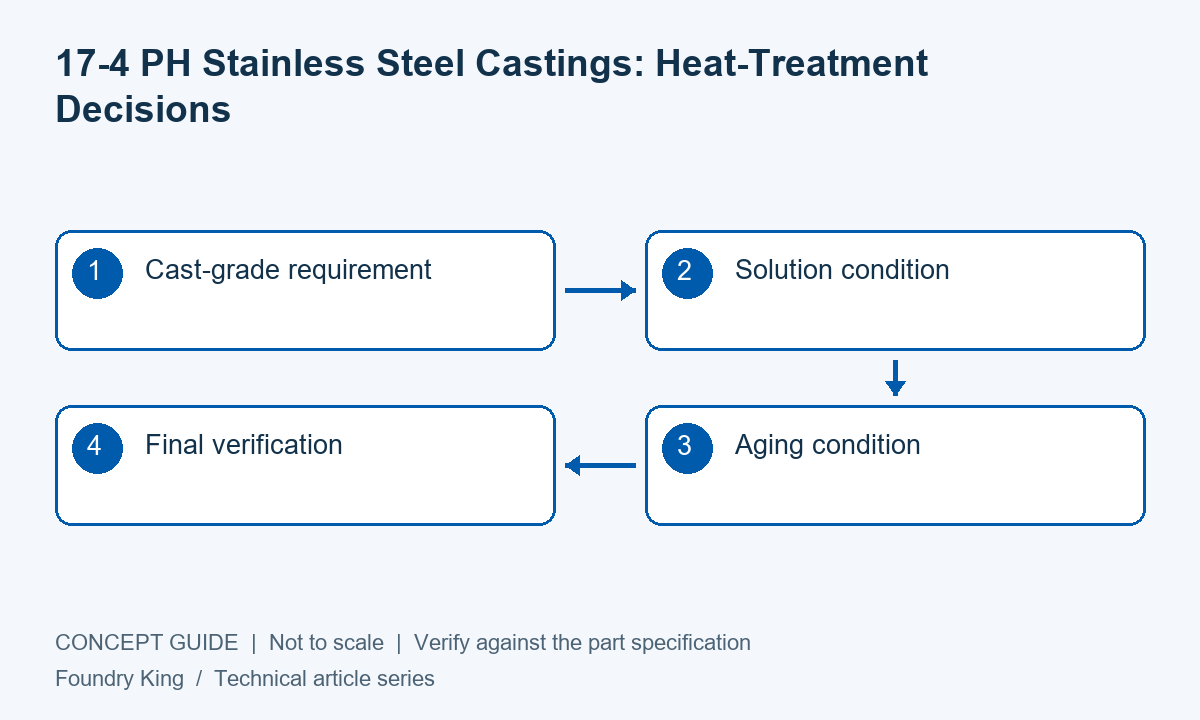
Confirm the casting designation
The familiar 17-4 PH name is used across product forms. A casting order must identify the applicable cast-grade standard and requirements rather than relying on a bar-stock specification. Review chemistry, mechanical properties, treatment and testing for the actual product being purchased.
If an equivalent grade is proposed, document the comparison and obtain engineering approval. Similar nominal chemistry does not establish that processing, test requirements or allowable conditions are identical. Keep the drawing, quotation and material certificate aligned.
Choose the condition for the duty
Higher nominal strength is not automatically the best choice. Toughness, stress, temperature and environmental behavior can influence the selected aging condition. The equipment designer should establish the required condition and properties rather than leaving the supplier to choose an unspecified hardening route.
Avoid publishing a single strength or hardness as though it applies to every 17-4 PH casting. Values depend on the specified condition and governing requirements. Where a performance claim matters, use the relevant standard and traceable test evidence.
Coordinate machining and dimensional checks
Decide which operations occur before and after heat treatment. Processing can affect dimensions, while the material condition changes machining behavior. The planned sequence should maintain sufficient stock for cleanup and preserve the datum relationship needed for final inspection.
For slender or asymmetric features, discuss distortion risk before tooling release. A casting that meets dimensions at an intermediate stage may move during subsequent treatment or finishing. Specify when the final dimensional acceptance is performed.
Review the required evidence
| Topic | Question | Purchase requirement |
|---|---|---|
| Product form | Which casting specification governs? | Approved cast grade and standard |
| Condition | What aging or delivery condition is required? | Documented processing and test basis |
| Final geometry | When are critical dimensions verified? | Inspection after relevant processing |
Include repairs and surface processing
If weld repair is permitted, define the procedure, approval and post-repair requirements. The original material certificate does not automatically establish the condition of a repaired area after additional thermal processing. Review the complete route with the responsible technical parties.
Cleaning and contamination control remain important for stainless components. Specify any application-required treatment and ensure identification survives finishing. A traceable record of the delivered condition is essential when the same component is reordered or replaced years later.
Frequently asked questions
Is “17-4 PH” enough information for a purchase order?
No. Identify the cast-grade specification, delivery condition, testing and component requirements.
Should the highest-strength condition always be selected?
No. The appropriate balance of properties depends on the duty, environment and design requirements.
Discuss your component requirements
For related information, review stainless cast components, or review precipitation-hardening requirements. Include the drawing revision, alloy, quantities and critical acceptance requirements so the proposed route can be reviewed against the actual part.

Get Premium Casting Products
Join foundryking.com Newsletter to get more information of different premium OEM Casting products in China.


