

 By Coco
Link the cast grade to fabrication and corrosion requirements.
CF3M vs CF8M is often discussed when a stainless casting will be welded, repaired or exposed to a corrosion-sensitive service. Carbon control is relevant, but the grade choice should still follow a complete material specification. Low carbon is not a substitute for suitable heat treatment, clean fabrication and an application-specific acceptance plan.
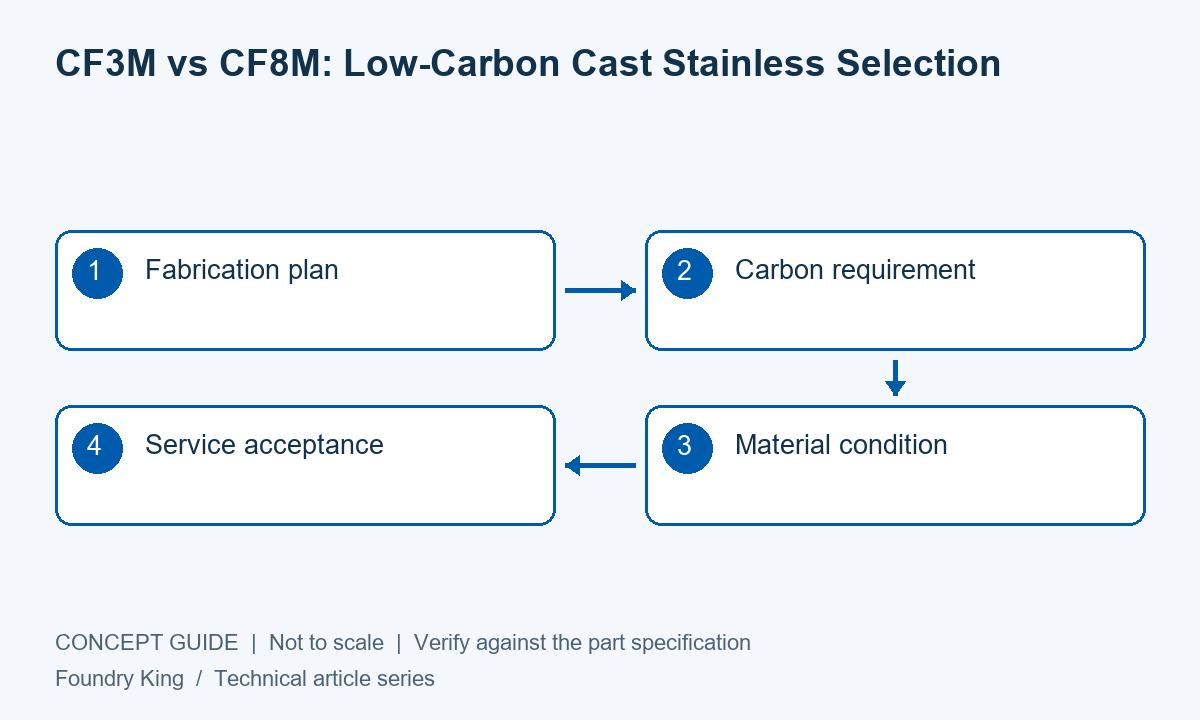
Explain why carbon is being considered
Ask whether the concern comes from welding, the service environment or a specific customer requirement. Understanding the reason prevents a grade substitution from becoming a vague attempt to buy a generally better material. The designer should identify which failure mechanism or specification provision the choice addresses.
Do not use a single carbon-related explanation to predict every form of corrosion. Pitting, crevice attack, stress corrosion and other mechanisms involve additional factors. The complete chemistry, microstructure, condition and environment must be considered where relevant.
Specify the cast-grade standard
Common wrought stainless labels can help explain alloy families, but they do not replace the casting purchase specification. State the applicable grade, standard, delivery condition and testing. Review any claimed equivalence against the actual requirements rather than assuming the names are interchangeable.
If weld repair is planned or may be allowed, address it before production. The required procedure, approval, heat treatment and examination can affect cost and lead time. An acceptable base material does not automatically make every repair practice acceptable.
Control finishing and contamination
The component’s surface condition can influence corrosion behavior. Review cleaning after cutting, grinding, welding and machining, especially where tools or handling could introduce contamination. Any passivation or other treatment should be specified where required, not assumed from a bright surface.
Internal passages also need attention. An inaccessible region can retain debris or create a service crevice. Material selection and geometry should be reviewed together rather than expecting a low-carbon grade to compensate for every design or cleanliness issue.
Compare the whole requirement
| Question | Why it matters | Required decision |
|---|---|---|
| Will the part be welded? | Fabrication can affect local material condition | Approved procedure and post-processing |
| What environment applies? | Corrosion mechanisms differ | Application-specific grade assessment |
| What does the drawing require? | Substitutions can change the design basis | Controlled material approval |
Keep records aligned
Ensure the grade on the drawing, purchase order and material certificate agrees. Maintain heat traceability through final machining and any approved repair. If a substitution is proposed because of availability, obtain approval before pouring rather than accepting the certificate after delivery as a fait accompli.
Where service conditions are uncertain, obtain additional information rather than publishing a universal suitability claim. A material-selection record should explain why the grade was chosen and what assumptions apply. This is more useful for future replacement orders than a comparison based only on nominal composition.
Frequently asked questions
Is lower carbon always the better purchasing choice?
Not automatically. The correct grade depends on the governing specification, processing and application, including any required mechanical properties.
Does selecting CF3M remove the need for welding controls?
No. Appropriate procedure, condition, cleaning and inspection remain necessary.
Discuss your component requirements
For related information, review cast stainless steel components, or clarify low-carbon stainless requirements. Include the drawing revision, alloy, quantities and critical acceptance requirements so the proposed route can be reviewed against the actual part.

Get Premium Casting Products
Join foundryking.com Newsletter to get more information of different premium OEM Casting products in China.


