

 By Coco
Select a material condition that fits the part rather than choosing by alloy label alone.
Carbon steel vs alloy steel castings is a comparison of specific grades, processing conditions and component duty. Alloy additions can change hardenability and other material behavior, but more alloy content does not automatically produce a better part. The finished casting must meet the design’s strength, toughness, wear and environmental requirements in its supplied condition.
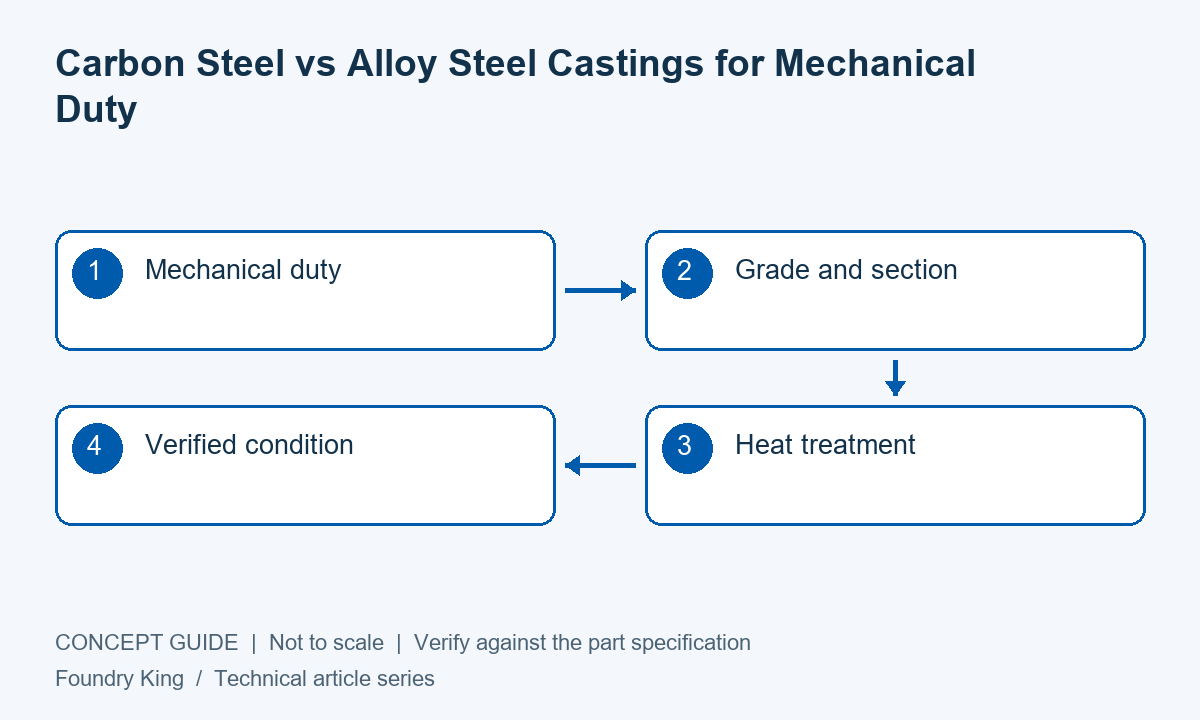
Define the mechanical requirement
State the relevant loads, operating temperature and required properties. A slowly loaded support and a highly stressed cyclic component may need different material strategies. If impact properties or low-temperature behavior matter, include the required test conditions rather than assuming tensile strength covers them.
Section size influences the relationship between processing and local properties. A property measured on a representative test piece must be interpreted according to the governing specification. Do not transfer data from a small wrought specimen to a large cast section without the required technical review.
Review the heat-treatment condition
The grade and heat-treatment route work together. A chemistry description alone may leave the intended mechanical condition unclear. Specify the required delivery condition and any documentation needed to show that the processing and testing requirements have been met.
Heat treatment can also affect dimensions and machining plans. Decide which operations occur before and after treatment, and when the critical geometry is checked. A dimensional report from an intermediate stage may not represent the final delivered component.
Include fabrication and maintenance needs
Welding, repair, machining and surface processing can influence the choice. Some alloy and condition combinations need special procedures or may be restricted by the specification. Discuss these requirements before production, including whether weld repair is allowed and how it must be approved.
For service replacements, consider compatibility with existing parts and the original design basis. A stronger replacement may shift loads to neighboring components or change repair practice. Grade substitution should therefore remain an engineering decision rather than an informal purchasing upgrade.
Compare complete specifications
| Selection item | Carbon steel route | Alloy steel route |
|---|---|---|
| Grade | Defined standard and condition | Defined standard and condition |
| Processing | Treatment needed for the required properties | Treatment matched to alloy and section |
| Verification | Required mechanical and integrity evidence | Required mechanical and integrity evidence |
Quote the finished requirement
Ask suppliers to include the same material testing, heat treatment, machining and inspection. Different quoted conditions can make a lower material price misleading. The most useful comparison is the cost of conforming finished components, not a price per kilogram attached to a broad alloy family.
Retain the approved material and processing records for repeat supply. If a grade becomes unavailable, review the proposed alternative against every relevant requirement. Similar nominal strength does not establish equivalent fatigue, toughness, corrosion or fabrication behavior.
Frequently asked questions
Is alloy steel always stronger than carbon steel?
No. Specific grade and processing condition determine properties, and strength is only one part of suitability.
Can a casting grade be replaced by a similarly named bar grade?
Not automatically. Product form and specification requirements differ and require review.
Discuss your component requirements
For related information, review steel casting components, or discuss an alloy and delivery condition. Include the drawing revision, alloy, quantities and critical acceptance requirements so the proposed route can be reviewed against the actual part.

Get Premium Casting Products
Join foundryking.com Newsletter to get more information of different premium OEM Casting products in China.


