

 By Coco
Keep the alloy result connected to the actual parts delivered.
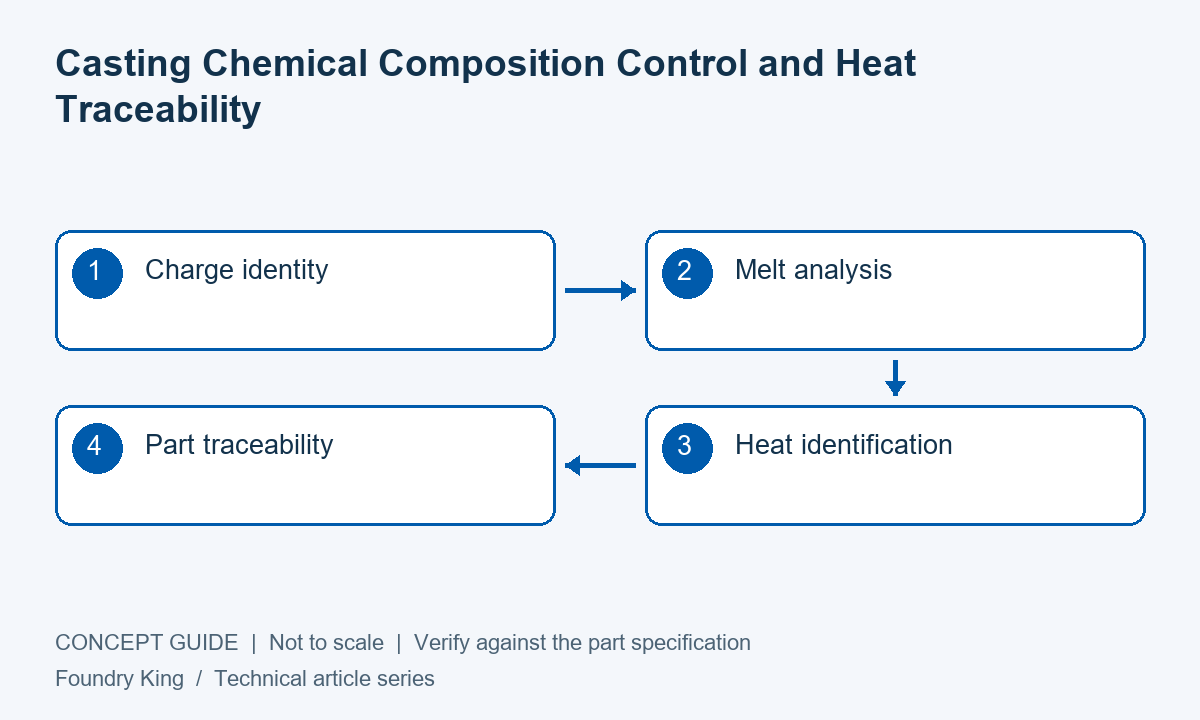
Casting chemical composition control establishes whether the metal’s analyzed chemistry meets the specified alloy requirements. It is essential, but it is not the whole material acceptance process. Properties, heat treatment and casting integrity may require separate evidence. The chemistry result is most useful when its sample and heat identity remain traceable to the delivered components.
Specify the alloy unambiguously
Provide the applicable material standard, grade, edition where relevant and any supplementary requirements. Similar common names can describe different product forms or conditions. A wrought-material designation should not automatically be treated as a complete casting purchase specification.
If a supplier proposes an alternative grade, compare chemistry, mechanical requirements, heat treatment and testing. An apparent chemical match does not establish full equivalence. Obtain engineering approval where the substitution changes the original design basis.
Understand what the analysis represents
Ask how the sample is identified and at which stage it represents the production heat. Different specifications distinguish forms of analysis and permitted limits, so the certificate must be interpreted against the actual governing requirements. A copied composition table is not evidence that a particular heat was tested.
The foundry’s controls also include charge identification, alloy additions and prevention of mix-ups. Buyers usually do not need the proprietary melt recipe, but they do need confidence that the analyzed material and supplied parts belong to the same controlled production record.
Preserve identity after the pour
Heat marks, tags, travelers and other controlled methods may carry identification through cleaning, treatment and machining. Some physical markings disappear during finishing, so the route must explain how identity is transferred before that happens.
Where a batch contains several heats, segregate and record them appropriately. A certificate covering one heat should not be assumed to cover visually identical parts from another. Receiving inspection should reconcile quantities and identification with the supplied documentation.
Check the documentation chain
| Record | What to verify | Gap to avoid |
|---|---|---|
| Purchase specification | Grade and required condition | A generic family name only |
| Analysis report | Sample and heat identity | Unlinked chemistry results |
| Delivery records | Part or batch connection to heat | Mixed parts with one unexplained certificate |
Keep other acceptance requirements visible
Chemistry alone does not demonstrate mechanical performance, corrosion behavior or freedom from defects. Heat treatment, microstructure and production quality can influence those outcomes. Build the material review into the wider inspection plan rather than treating a correct analysis as permission to skip the remaining checks.
For repeat supply, control changes to grade, route and identification. If a marking method or subcontractor changes, confirm that traceability remains intact. That is especially important when castings are machined, split into several components or held in stock before delivery.
Frequently asked questions
Does a positive material identification result replace every certificate?
No. It provides the information its method can establish and does not automatically replace the specified chemistry, mechanical or processing records.
Are two grades equivalent if their major alloying elements are similar?
Not necessarily. Product form, limits, processing, properties and test requirements can differ.
Discuss your component requirements
For related information, review review steel casting families, or clarify material and traceability requirements. Include the drawing revision, alloy, quantities and critical acceptance requirements so the proposed route can be reviewed against the actual part.

Get Premium Casting Products
Join foundryking.com Newsletter to get more information of different premium OEM Casting products in China.


