

 By Coco
Establish when the crack formed before selecting a prevention or repair strategy.
Hot tearing in castings occurs during the late stages of solidification when the developing material cannot accommodate imposed strain. Cracking can also occur later, after the part has solidified, during cooling, heat treatment, handling or service. The distinction matters because a remedy directed at mold restraint may not resolve a later heat-treatment or loading problem.
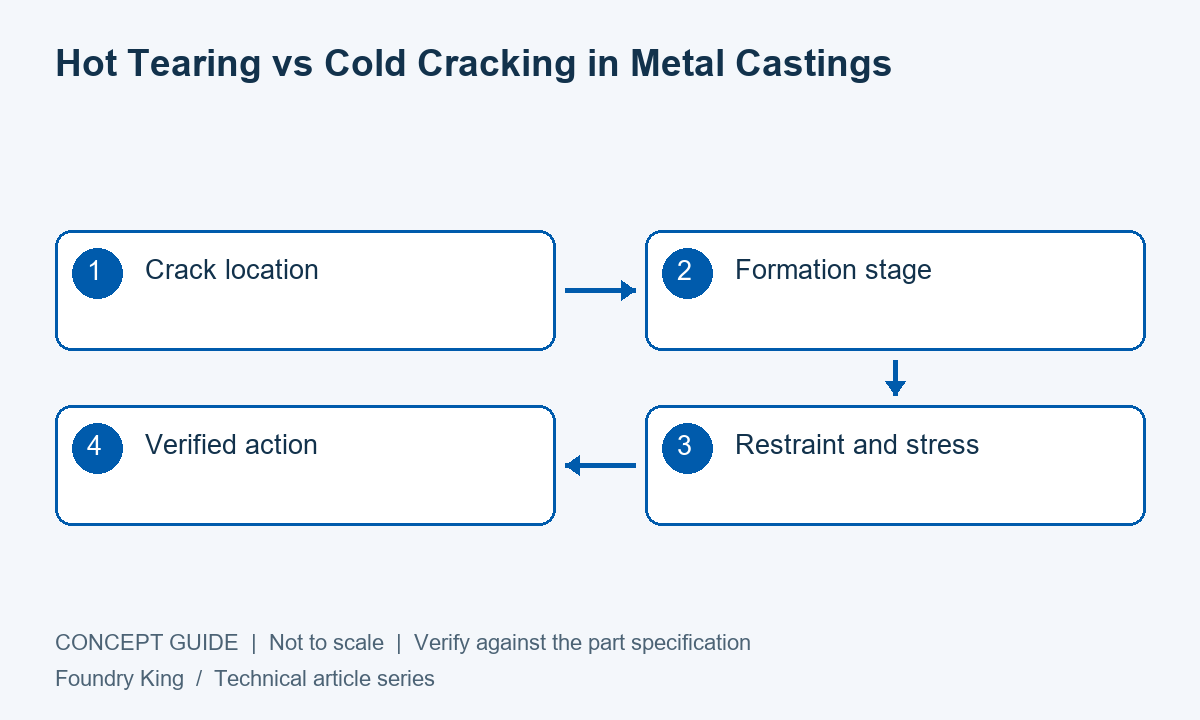
Establish the sequence of events
Record the first stage at which the crack was observed. Review as-cast inspections, heat-treatment records, straightening and machining history. A crack discovered after machining was not necessarily created by machining; material removal may simply have exposed an existing discontinuity.
Photograph the crack’s position and extent before repair or heavy blending. Where appropriate, obtain specialist examination of the fracture or section. The aim is to relate the evidence to a formation mechanism, not to select a familiar label from appearance alone.
Review restraint during solidification
As the casting contracts, geometry and mold or core restraint can produce local strain. Abrupt section changes, long constrained members and unfavorable junctions may deserve attention. A local fillet or a change in core behavior can influence the result, but the correct solution depends on the complete design and process.
The alloy’s solidification characteristics matter too. Do not assume the behavior of one steel or nonferrous alloy represents every grade. The foundry should review chemistry, thermal conditions and geometry together when investigating a repeated hot-tearing location.
Investigate later stress sources
After solidification, uneven cooling, transformation behavior, heat treatment and straightening can create other cracking risks. Service loading can introduce yet another mechanism. Preserve the processing history and distinguish manufacturing acceptance from failure analysis of a used component.
Inspection methods must suit the material and crack location. Surface methods and volumetric methods provide different evidence. Agree the examination stage and criteria, particularly where subsequent machining could remove a surface indication or expose a subsurface one.
Choose actions that address the cause
| Evidence direction | Possible review area | Validation needed |
|---|---|---|
| Repeated crack at a restrained junction | Geometry, core restraint and solidification | Representative casting trial |
| Crack first evident after treatment | Heating/cooling route and material condition | Processing records and suitable examination |
| Crack after service | Loads, environment and original integrity | Application-specific failure investigation |
Control any proposed repair
Not all cracked castings may be repaired under the governing specification. Where repair is permitted, agree the method, qualification, heat treatment and post-repair examination. Grinding until an indication disappears is not enough if the remaining section or repair status is uncontrolled.
After corrective action, update the approved drawings or method documents and verify repeat results. The objective is stable conformity, not simply one crack-free sample. Keep the original evidence so later investigations can distinguish a recurring mechanism from a new issue.
Frequently asked questions
Can hot tearing be diagnosed only from the final crack shape?
Shape and location help, but formation stage, material and processing evidence are often necessary.
Does heat treatment repair every crack?
No. Heat treatment is not a general crack repair method and may itself require careful control to prevent damage.
Discuss your component requirements
For related information, review cast steel components, or discuss crack acceptance and investigation. Include the drawing revision, alloy, quantities and critical acceptance requirements so the proposed route can be reviewed against the actual part.

Get Premium Casting Products
Join foundryking.com Newsletter to get more information of different premium OEM Casting products in China.


