

 By Coco
Use the specified grade and operating duty instead of treating all cast iron as one material.
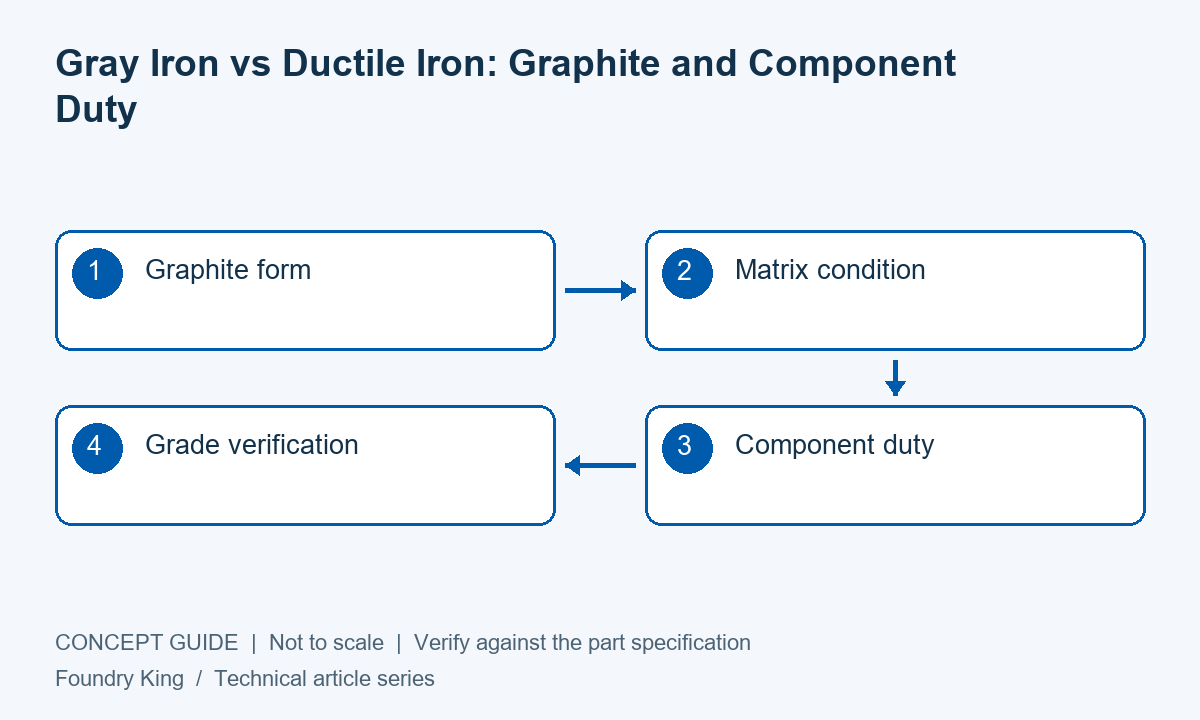
Gray iron vs ductile iron is fundamentally a comparison of material structure and component duty. Gray iron contains graphite flakes, while ductile iron has graphite in a predominantly nodular form. That difference influences behavior, but the matrix, grade and casting quality also matter. Selecting either family by name alone leaves important requirements undefined.
Connect structure to the application
Graphite shape affects how the material responds to stress. Gray iron is often considered where damping, machinability and compressive loading are important. Ductile iron provides different ductility and tensile behavior that can be useful for other mechanical duties. These are selection considerations, not universal approval for a particular part.
The matrix can change within each family through chemistry and processing. Do not transfer a property from a different grade or heat-treatment condition to the proposed component. Ask which material specification and delivery condition will govern the actual purchase.
Review the load path and section
A machine base, a rotating hub and a pressure-containing body present different risks. Provide the relevant load case and temperature, and identify impact or cyclic loading where it exists. The designer should establish acceptable properties rather than relying on a supplier to infer the duty from the product name.
Section thickness also affects production and material verification. The properties represented by a separate test piece may not describe every location in a complex casting without qualification. Agree the required testing and how it relates to the product specification.
Include wear and machining requirements
Wear behavior depends on more than nominal strength. Contact conditions, lubrication, mating materials and abrasive particles can dominate service life. A harder or stronger grade is not automatically the best solution for every wear situation.
For machined components, discuss hardness consistency, stock and the location of critical features. A casting selected for mechanical performance must also support the planned machining route. Tooling and inspection costs belong in the material comparison when they differ significantly.
Make the comparison explicit
| Question | Why it matters | Required clarification |
|---|---|---|
| What loads act on the part? | Separates rigidity, tension and impact needs | Defined duty and failure consequences |
| Which grade is ordered? | Material family alone is incomplete | Standard, grade and delivery condition |
| How will conformity be shown? | Different tests provide different evidence | Certificate, sampling and acceptance plan |
Approve changes through engineering
Replacing gray iron with ductile iron can change performance, machining behavior and cost. It should not be treated as a harmless upgrade without reviewing the application. The same applies to choosing a different ductile-iron grade because its nominal tensile strength is higher.
For repeat supply, retain the approved material requirements, identification and inspection route. If a replacement is being selected after a failure, investigate loading, geometry and operating conditions as well as the material. A more appropriate design or lubrication arrangement may matter more than a grade change.
Frequently asked questions
Is ductile iron simply a higher-quality version of gray iron?
No. They are distinct material families with different structures and useful applications. Quality means meeting the specified requirements.
Does the grade name define every inspection requirement?
Not always. Supplementary requirements, casting integrity and component-specific checks may need to be stated separately.
Discuss your component requirements
For related information, review iron casting applications, or review a cast-iron material specification. Include the drawing revision, alloy, quantities and critical acceptance requirements so the proposed route can be reviewed against the actual part.

Get Premium Casting Products
Join foundryking.com Newsletter to get more information of different premium OEM Casting products in China.


