

 By Coco
Choose by the difficult feature on the drawing, not by the name of the process.
Sand vs investment casting thin walls is a feature-level comparison. A component can have a simple outer profile but a difficult internal passage, or attractive near-net geometry but one heavily loaded thick junction. Instead of asking which process is universally more precise, identify the feature most likely to prevent a sound, clean and economically finished part.
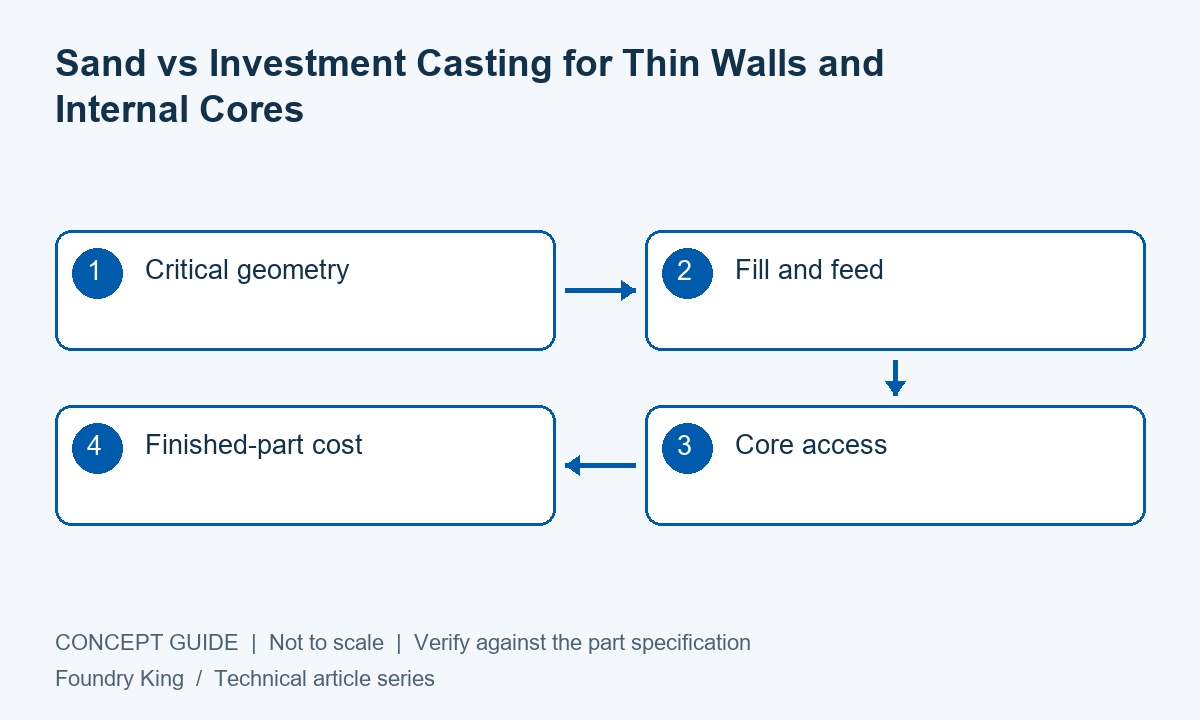
Map thin sections and flow paths
Thin-wall feasibility depends on alloy, flow distance, metal and mold conditions, and the filling arrangement. A short rib and a long thin shell are different challenges even when their nominal thickness is the same. Avoid applying a supplier’s example minimum thickness to an unrelated component.
Investment casting can reproduce detailed geometry using expendable patterns and ceramic shells. Sand routes offer a range of molding and core options. In both cases, review where metal enters, how it reaches remote features and whether local heavy sections can be fed during solidification.
Examine the internal passage separately
A sand core can form a passage that is difficult to create by machining alone. Investment casting may also use cores or other methods for internal features, depending on the route. The decisive issues are support, wall control, core removal and inspection, rather than assuming one process produces every cavity without additional engineering.
Provide a cleaning requirement for inaccessible flow channels. If the part must be free of residue, ask how that will be demonstrated. A complicated passage that can be formed but not cleaned may need a design change regardless of the chosen casting method.
Compare finishing and machining
A finer as-cast surface may reduce some finishing work without eliminating machining of sealing or bearing interfaces. Evaluate the actual critical features and locating method. A casting that saves material but is awkward to fixture can lose its expected cost advantage during machining.
Agree where parting witnesses, gate scars and blended surfaces may remain. Their location can affect assembly, flow and appearance. This discussion often changes the preferred route more effectively than a general claim about typical surface finish.
Build a feature-based comparison
| Feature | Sand route review | Investment route review |
|---|---|---|
| Long thin section | Filling distance and mold behavior | Pattern stability and shell/filling capability |
| Complex internal cavity | Core support and cleaning access | Available core route and removal validation |
| Critical mating face | Stock, datums and machining setup | Stock, gate placement and final machining |
Request comparable evidence
Ask both suppliers to quote the same alloy, quantity, finished condition and inspection requirements. Identify what is included in tooling and whether the sample route matches production. Otherwise, the lower quotation may exclude work that the other route includes.
For an uncertain feature, a focused trial or simulation can help evaluate feasibility. Use the result to update the drawing and acceptance plan. Neither method should be selected solely because a similar-looking component was made successfully somewhere else.
Frequently asked questions
Is investment casting always better for a thin wall?
No. The alloy, geometry and process capability must be reviewed. A nominal thickness alone is not a sufficient selection criterion.
Should both routes receive the same finished drawing?
Yes, with the same quantity and acceptance requirements. Each supplier can then propose a separate casting and machining route for review.
Discuss your component requirements
For related information, review broader process comparison, or compare a specific drawing. Include the drawing revision, alloy, quantities and critical acceptance requirements so the proposed route can be reviewed against the actual part.

Get Premium Casting Products
Join foundryking.com Newsletter to get more information of different premium OEM Casting products in China.


