

 By Coco
Specify the usable machined section rather than assuming the complete cast wall is finished material.
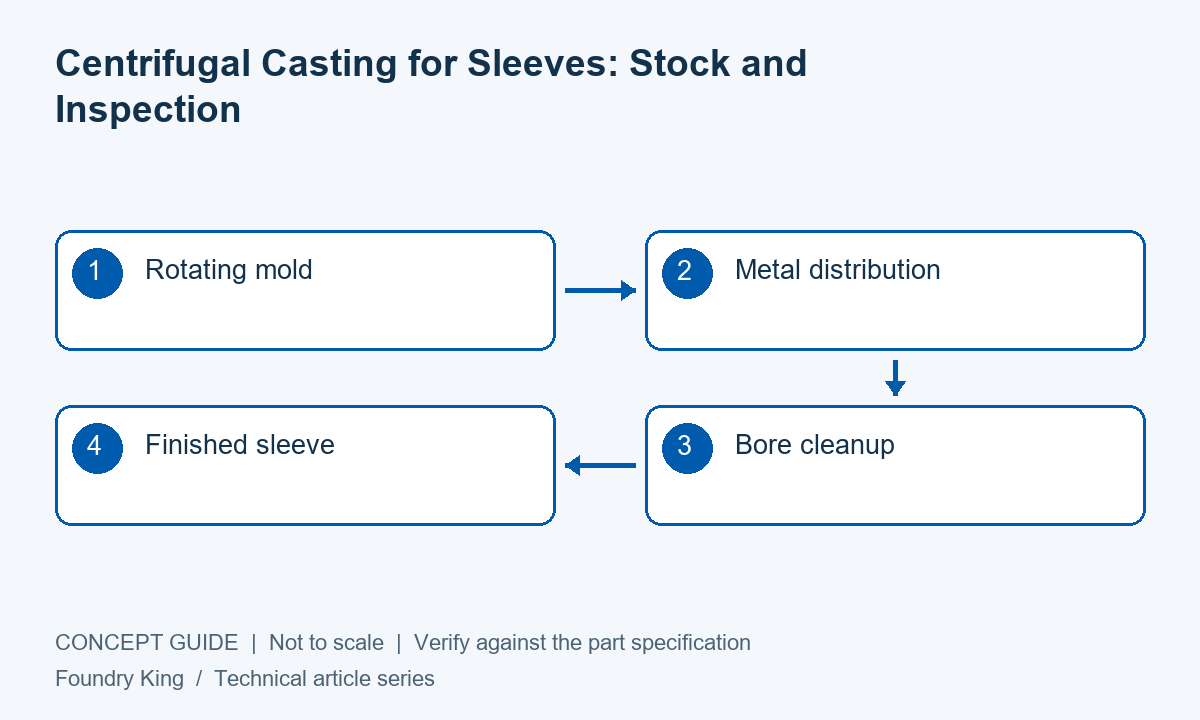
Centrifugal casting sleeves are produced by rotating a mold while metal solidifies against its wall. The route is particularly relevant to ring, tube and sleeve geometries. For a buyer, the critical issue is not simply obtaining a hollow casting: it is establishing the usable section after the inner and outer surfaces are machined to the required dimensions.
Define the finished envelope
Provide the final outside diameter, bore, length and relevant concentricity requirements. The foundry also needs machining allowances and the agreed delivery condition. A cast tube ordered only by approximate outside diameter and weight may leave inadequate stock for bore cleanup or the required machining setup.
Explain where the sleeve runs, seals or carries load. Bearing surfaces, interference fits and pressure-containing walls need different checks. If the component will be sectioned into several rings, include cutting losses and the end material that must be removed before the first usable ring is produced.
Understand the inner surface
Rotation influences how the metal and some less-dense material distribute during solidification. The inner region may therefore require planned removal. It is unsafe to assume that the rough bore is immediately suitable as a running or sealing surface without the specified machining and inspection.
The amount of cleanup depends on the alloy, diameter, wall and foundry method. Agree it with the producer instead of assigning one universal allowance. If an economical stock size is proposed, verify that it still leaves sufficient material for the final bore, outside diameter and length.
Coordinate material and heat treatment
Bronze, iron and steel sleeves require different material specifications and processing routes. State the actual alloy or grade, heat-treatment condition if applicable and any required test evidence. A generic request for “high strength bronze” is not enough to establish corrosion behavior, bearing compatibility or hardness.
Where a sleeve works against another component, discuss the material pair and lubrication conditions with the equipment designer. The casting route does not by itself determine acceptable fit, operating clearance or lubrication. Those requirements belong to the complete mechanical system.
Agree the inspection sequence
| Item | Before machining | After machining |
|---|---|---|
| Dimensions | Enough stock on bore, OD and ends | Final size, runout and relevant geometry |
| Material | Grade identity and specified condition | Traceability retained on separated pieces |
| Integrity | Agreed examination of usable section | Check defects exposed by bore cleanup |
Manage traceability when cutting stock
A long centrifugally cast tube may supply many finished components. Maintain the connection between the parent casting, heat records and individual pieces. If identification is removed during turning or cutting, the manufacturing plan needs another controlled method of carrying it forward.
Retain the agreed acceptance route for repeat orders. A change in supplied stock diameter, wall thickness or heat treatment can change the amount of machining and the final condition. Review substitutions against the finished sleeve rather than approving them only because the alloy designation matches.
Frequently asked questions
Does centrifugal casting eliminate every pore?
No manufacturing route guarantees defect-free material under all conditions. Specify suitable process control, machining stock and inspection for the actual application.
Can a centrifugally cast sleeve be supplied without machining?
It can be supplied as stock where appropriate, but the customer must allow for required cleanup and final dimensional control.
Discuss your component requirements
For related information, review review metal casting options, or discuss sleeve material and dimensions. Include the drawing revision, alloy, quantities and critical acceptance requirements so the proposed route can be reviewed against the actual part.

Get Premium Casting Products
Join foundryking.com Newsletter to get more information of different premium OEM Casting products in China.


