

 By Coco
Assess the geometry, tooling and acceptance requirements before selecting a resin-coated sand shell.
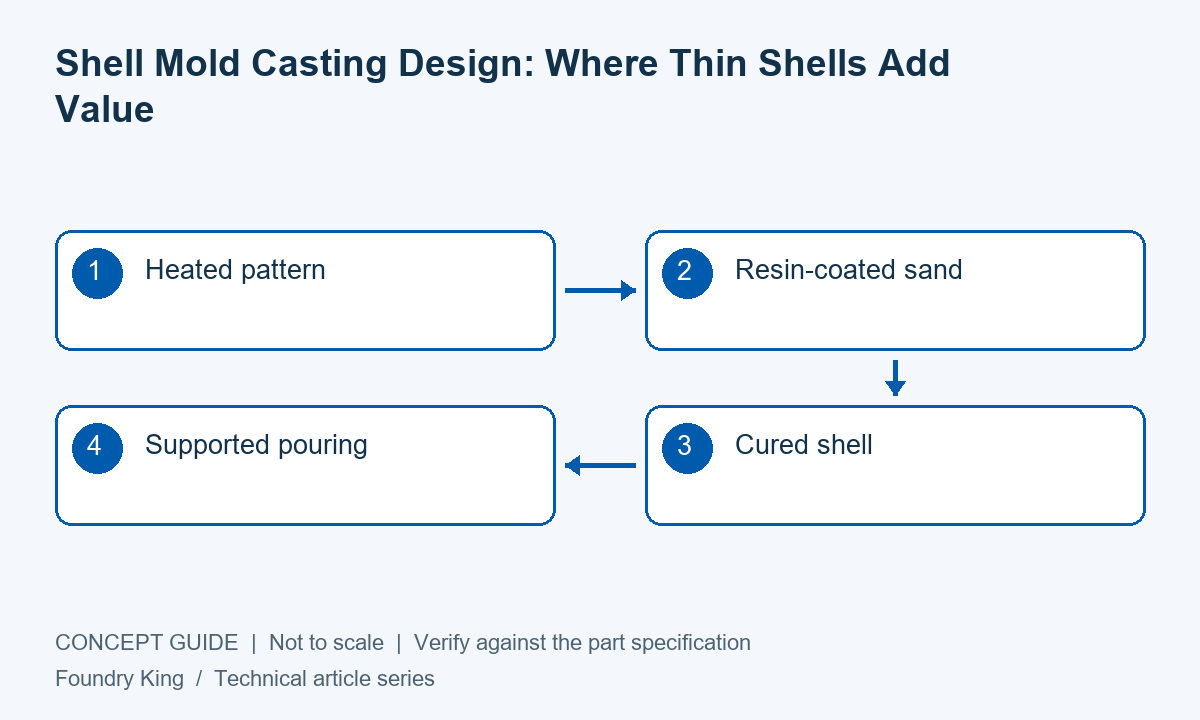
Shell mold casting design starts with a heated metal pattern and resin-coated sand, which forms a relatively thin, hardened shell. The process can offer useful surface definition and repeatability for suitable components, but its economic advantage depends on the geometry, tooling and production requirement. It should be compared using the finished part, not only the appearance of a cleaned casting.
Distinguish the shell from the support
The shell reproduces the pattern surface, while the complete mold arrangement must remain stable during pouring. Shell halves, supports and any cores need an assembly method that prevents movement and leakage. An accurate pattern does not compensate for inconsistent joining or damage during handling.
For hollow components, ask whether the internal features require separate cores and how those cores are located. The core system can become the dominant source of variation even when exterior shell surfaces repeat well. Include internal wall requirements in sample approval, not only external dimensions.
Design around the parting strategy
Parting lines, draft and accessible gate locations determine whether the component can be produced and finished efficiently. A deep recess or awkward flange can add tooling complexity or require extra mold sections. Review options such as splitting a boss, adjusting a transition or moving a nonfunctional feature before the metal pattern is finalized.
The surface needing the best control is not necessarily the most visible one. Bearing locations and assembly interfaces may be machined later, while an inaccessible flow passage remains as-cast. Prioritize the latter during the process review and define how its condition will be checked.
Evaluate tooling against expected demand
Heated metal tooling generally has a different cost structure from simpler pattern routes. A stable repeat requirement may justify that investment, while a one-off design still changing every month may not. Compare the cost of revisions and core boxes as well as the initial pattern price.
Request quotations for the same annual demand and delivery batch size. Tooling amortization over an optimistic lifetime quantity can hide the actual cash cost of a small first order. Clarify tooling ownership, storage and maintenance responsibilities before placing the purchase order.
Specify measurable acceptance
| Drawing concern | Review during design | Verify on samples |
|---|---|---|
| Parting mismatch | Location and assembly method | Step or displacement at agreed features |
| Internal geometry | Core location and support | Wall thickness and passage alignment |
| Functional faces | Machining stock and datums | Final dimensions after required processing |
Avoid an appearance-only approval
Shell molding can be selected partly for surface definition, but cosmetic quality is not the same as internal soundness. The feeding arrangement, alloy control and inspection plan still govern integrity. A smooth exterior can coexist with shrinkage in a heavy junction or gas defects associated with a core.
Choose inspection methods according to the application and specify the acceptance criteria. If a component retains pressure or carries cyclic loads, define the relevant test or quality requirements during the quotation stage. Do not assume a named molding process implies those tests are included in the price.
Frequently asked questions
Is shell molding the same as investment casting?
No. Shell molding uses resin-coated sand against a heated pattern. Investment casting forms a ceramic shell around expendable patterns and removes those patterns before pouring.
Should every fine feature be cast to final size?
Not necessarily. Features requiring precise fit may be more economical and reliable when cast with suitable machining stock.
Discuss your component requirements
For related information, review compare precision casting requirements, or request a tooling and geometry review. Include the drawing revision, alloy, quantities and critical acceptance requirements so the proposed route can be reviewed against the actual part.

Get Premium Casting Products
Join foundryking.com Newsletter to get more information of different premium OEM Casting products in China.


