

 By Coco
A practical guide to chemically bonded molds for industrial components.
No bake sand casting uses a chemically curing binder system to create a rigid mold without baking the complete mold in an oven. It is often considered for industrial components where mold strength, size or production flexibility is important. The correct route still depends on the alloy, geometry, quantity and inspection requirements; the process name alone does not guarantee better castings.
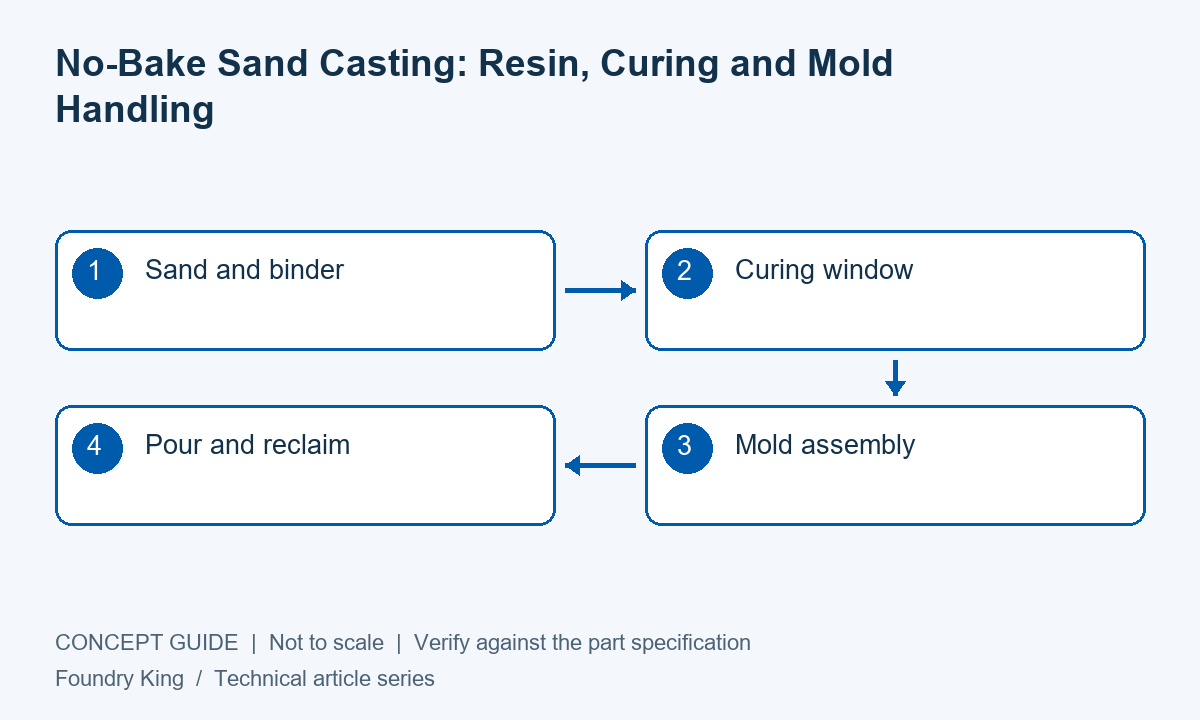
Understand the curing system
Sand, binder and catalyst must be mixed consistently and used within the workable time established for the chosen system. If the mixture begins to cure before compaction is complete, the resulting mold may not reproduce the pattern correctly. If stripping occurs too early, edges and deep features can be damaged during pattern removal.
Temperature and sand condition influence curing behavior. A foundry’s working limits should reflect its actual materials and seasonal conditions, not a fixed rule copied from a different operation. Ask how mixing equipment is checked and how operators distinguish work time from safe stripping time.
Review pattern withdrawal and handling
Rigid molds still require a feasible parting strategy. Undercuts, deep pockets and inadequate withdrawal clearance can make stripping difficult or require additional cores. Discuss these features before tooling manufacture, especially when an apparently minor design detail creates several fragile mold sections.
Large molds introduce lifting and assembly considerations. Handling damage may produce inclusions or local dimensional errors that are not obvious once the cope and drag are closed. Mold preparation, coating where applicable, and inspection before closure should be part of the route.
Account for cores and gas escape
The core package affects both internal geometry and gas management. Binder decomposition during pouring produces gases that need a controlled escape path. More binder may increase strength while creating other difficulties, so the correct balance should be established through process development and evidence.
Specify cleanliness requirements for internal passages and identify features that cannot be inspected directly. For a complex housing, a trial section or suitable internal inspection may provide more useful evidence than an exterior photograph. Coordinate this with the customer’s acceptance needs rather than adding unplanned destructive tests after sample delivery.
Compare the right production factors
| Factor | No-bake consideration | Buyer’s question |
|---|---|---|
| Tooling | Parting, cores and stripping method | Can the drawing be simplified before tooling? |
| Repeatability | Mixing, cure and assembly control | Will samples use the intended production route? |
| Waste | Binder choice and sand reclamation | What reclamation system is actually available? |
Evaluate the finished casting
No-bake castings may still need blasting, grinding, heat treatment and machining. Agree which surfaces are functional, where gate removal is permitted and what inspection stage controls acceptance. Do not treat mold rigidity as proof of a specific surface roughness or tolerance class without a documented capability review.
For a repeat order, record the approved process drawing and revision. If a different binder, sand or pattern arrangement is proposed, review the effect on dimensions, surface condition and test requirements. A controlled change process helps prevent a successful first batch from becoming an unrepeatable exception.
Frequently asked questions
Are resin sand and no-bake always identical terms?
Resin sand is broader terminology. Confirm whether the supplier means a room-temperature self-setting route, shell molding or another resin-bonded process.
Is no-bake automatically cheaper than green sand?
No. Tooling, mold labor, binder consumption, reclamation, quantity and machining all influence delivered cost.
Discuss your component requirements
For related information, review industrial steel casting requirements, or discuss a no-bake casting project. Include the drawing revision, alloy, quantities and critical acceptance requirements so the proposed route can be reviewed against the actual part.

Get Premium Casting Products
Join foundryking.com Newsletter to get more information of different premium OEM Casting products in China.


