

 By Coco
Follow the production checkpoints that turn a drawing into a repeatable industrial casting.
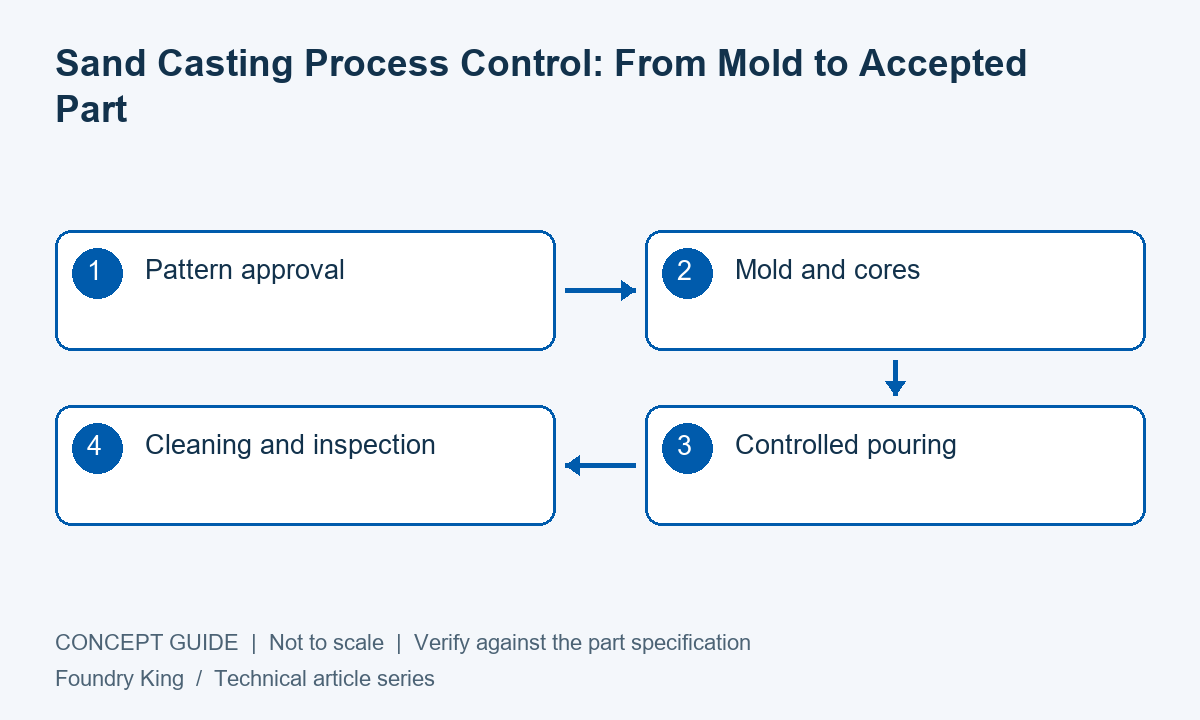
Sand casting process control is more useful to a buyer than a simple list of foundry operations. A housing may look correct after cleaning yet contain an inaccessible sand pocket, insufficient machining stock or a displaced bore. The purchasing question is therefore not merely how the metal is poured, but how each production stage protects the final part’s function.
Start with the finished component
Separate finished dimensions from as-cast dimensions before the pattern is made. Mark sealing faces, bearing seats, threaded connections and reference datums. A dimension that will be machined needs a machining allowance and a stable way to locate the casting; it should not automatically be treated as an as-cast acceptance dimension. Identify passages that must be free of residual core sand, especially where trapped debris could damage a pump or hydraulic circuit.
The pattern incorporates allowances for contraction and the chosen molding route. These are foundry engineering decisions, not a single percentage that works for every metal and geometry. Agree which drawing controls the finished product and how the foundry’s casting drawing will be approved. This prevents tooling adjustments from quietly changing the customer’s interface requirements.
Control the mold and core package
The sand system has to provide sufficient strength, permeability and dimensional stability for the selected alloy. In green sand, moisture and compactability affect mold behavior; chemically bonded systems depend on mixing, curing and handling conditions. A mold that survives handling may still behave poorly during filling, so strength alone is not a complete quality indicator.
Core location deserves its own checkpoint. Check core prints, support, assembly clearance and orientation against the intended wall thickness. If a core moves, an internal wall can become too thin even when exterior dimensions pass. For a new hollow casting, consider sectioned samples or a suitable internal inspection method before relying on external measurement alone.
Manage pouring and solidification together
Gates deliver metal; risers provide liquid feed as the casting solidifies. Their positions affect turbulence, inclusions, feeding and the location of last-to-freeze regions. A pouring-temperature change cannot reliably compensate for a poorly fed heavy junction. Review abrupt section changes, isolated bosses and thick intersections with the foundry before approving tooling.
The operating record should connect the pour to the alloy heat, mold batch and agreed inspection route. When a defect occurs, that traceability helps determine whether it is local to a mold, associated with a heat, or repeated by the method. Record meaningful process evidence rather than collecting paperwork without a link to accepted parts.
Define practical inspection gates
| Stage | Evidence to request | Problem it can reveal |
|---|---|---|
| First sample | Dimensional report using agreed datums | Core shift or insufficient machining stock |
| After cleaning | Visual criteria and passage-cleanliness check | Fins, adhered sand or inaccessible residue |
| After machining | Critical dimensions and relevant leak test | Exposed porosity or sealing-face defects |
Accept the part, not only the appearance
A useful sample review includes photographs, dimensional results, material identification and a record of any approved repair. Nondestructive testing should follow the part’s risk and an agreed acceptance specification; asking for “NDT passed” without method, coverage and criteria leaves the result ambiguous. For pressure-retaining components, distinguish material-soundness checks from the specified pressure or leak test.
For repeat orders, retain the approved revision and first-article record as the baseline. If the foundry changes the pattern, gating, production location or alloy route, agree whether renewed approval is needed. That discipline is particularly valuable for long-running equipment where a casting must remain interchangeable with earlier deliveries.
Questions before releasing an order
Ask which features remain as-cast, how cores will be located, what surfaces need machining stock, and how clean internal passages must be. Then confirm inspection coverage, traceability and deviation approval. A detailed drawing discussion usually prevents more rework than adding a vague request for “premium quality” to a purchase order.
Frequently asked questions
Does sand casting always require machining?
No. Noncritical surfaces can often remain as-cast, while mating, sealing or bearing features commonly need machining. The drawing and functional requirements determine the route.
Can one sample prove repeatability?
A sample demonstrates one result. Repeatability needs a controlled method, records and an inspection plan appropriate to the production volume and risk.
Discuss your component requirements
For related information, review iron and aluminum casting options, or discuss a casting drawing. Include the drawing revision, alloy, quantities and critical acceptance requirements so the proposed route can be reviewed against the actual part.

Get Premium Casting Products
Join foundryking.com Newsletter to get more information of different premium OEM Casting products in China.


